What a winning combination?
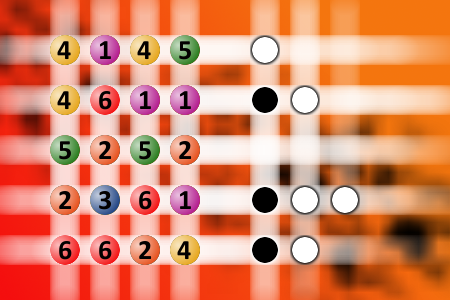
[3828] What a winning combination? - The computer chose a secret code (sequence of 4 digits from 1 to 6). Your goal is to find that code. Black circles indicate the number of hits on the right spot. White circles indicate the number of hits on the wrong spot. - #brainteasers #mastermind - Correct Answers: 45 - The first user who solved this task is Manguexa Wagle
BRAIN TEASERS
enter your answer and press button OK

What a winning combination?

The computer chose a secret code (sequence of 4 digits from 1 to 6). Your goal is to find that code. Black circles indicate the number of hits on the right spot. White circles indicate the number of hits on the wrong spot.
Correct answers: 45
The first user who solved this task is Manguexa Wagle.
#brainteasers #mastermind
Register with your Google Account and start collecting points.
Check your ranking on list.

World Post Day Jokes

On 9th October we celebrate World Post Day! Here's some postal humor for you:

What’s a postman’s favorite type of music?
Mail-ody!

Why did the feminist refuse to work at the post office?
Because it was a mail dominated industry

Have you heard about the dyslexic spy who got caught with a suitcase nuke in the post office?
Fission mailed!

So I got a phone call from the post office today...
...complaining that my dog is attacking a postman on a bike. But I told them "It can't be my dog... he doesn't even know how to ride a bike".

Did you hear that the Post Office just recalled their latest stamps?
They had pictures of lawyers on them ...and people couldn't figure out which side to spit on.

#worldpostday
Jokes of the day - Daily updated jokes. New jokes every day.
Follow Brain Teasers on social networks

Brain Teasers

puzzles, riddles, mathematical problems, mastermind, cinemania...

Deuterium

In 1933, Ernest Rutherford suggested the names diplogen for the newly discovered heavy hydrogen isotope and diplon for its nucleus. He presented these ideas in the Discussion on Heavy Hydrogen at the Royal Society. For ordinary hydrogen, the lightest of the atoms, having a nuclues of a sole proton, he coined a related name: haplogen. (Greek: haploos, single; diploos, double.) In 1931, Harold Urey had discovered small quantities of atoms of heavy hydrogen wherever ordinary hydrogen occurred. The mass of its nucleus was double that of ordinary hydrogen. This hydrogen-2 is now called deuterium, as named by Urey (Greek: deuteros, second). Its nucleus, named a deuteron, has a neutron in addition to a proton.[ref: Proc. Roy. Soc. A, vol. 144 (1934)]
This site uses cookies to store information on your computer. Some are essential to help the site properly. Others give us insight into how the site is used and help us to optimize the user experience. See our privacy policy.