What a winning combination?
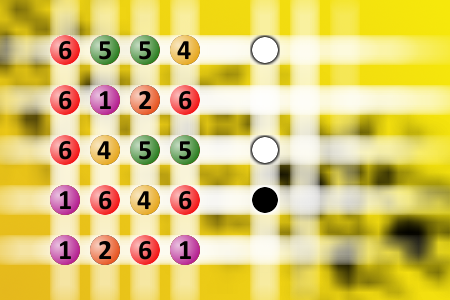
[4611] What a winning combination? - The computer chose a secret code (sequence of 4 digits from 1 to 6). Your goal is to find that code. Black circles indicate the number of hits on the right spot. White circles indicate the number of hits on the wrong spot. - #brainteasers #mastermind - Correct Answers: 50 - The first user who solved this task is Manguexa Wagle
BRAIN TEASERS
enter your answer and press button OK

What a winning combination?

The computer chose a secret code (sequence of 4 digits from 1 to 6). Your goal is to find that code. Black circles indicate the number of hits on the right spot. White circles indicate the number of hits on the wrong spot.
Correct answers: 50
The first user who solved this task is Manguexa Wagle.
#brainteasers #mastermind
Register with your Google Account and start collecting points.
Check your ranking on list.

Cabbie

One dismal rainy night in Sydney a taxi driver spotted an arm waving from the shadows of an alley. Even before he rolled to a stop at the curb, a figure leaped into the cab and slammed the door.

Checking his rear view mirror as he pulled away, he was startled to see a dripping wet, naked woman sitting in the back seat.

'Where to?' he stammered.

'Kings Cross,' answered the woman.

'You got it,' he said, taking another long glance in the mirror.

The woman caught him staring at her and asked, 'Just what the hell are you looking at, driver?'

'Well, madam,' he answered, 'I was just wondering how you'll pay your fare.'

The woman spread her legs, put her feet up on the front seat, smiled at the driver and said,

'Does this answer your question?'

Still looking in the mirror, the cabbie asked, 'Got anything smaller?'

Jokes of the day - Daily updated jokes. New jokes every day.
Follow Brain Teasers on social networks

Brain Teasers

puzzles, riddles, mathematical problems, mastermind, cinemania...

Wolfgang Paul

Died 6 Dec 1993 at age 80 (born 10 Aug 1913).German physicist who developed the Paul trap, an electromagnetic device that captures ions and holds them long enough for study and precise measurement of their properties. During the 1950s he developed the so-called Paul trap as a means of confining and studying electrons. The device consists of three electrodes - two end caps and an encircling ring. The ring is connected to an oscillating potential. The direction of the electric field alternates; for half the time the electron is pushed from the caps to the ring and for the other half it is pulled from the ring and pushed towards the caps. For his work he shared the 1989 Nobel Prize for Physics with Hans Georg Dehmelt and Norman F. Ramsey.
This site uses cookies to store information on your computer. Some are essential to help the site properly. Others give us insight into how the site is used and help us to optimize the user experience. See our privacy policy.