What a winning combination?
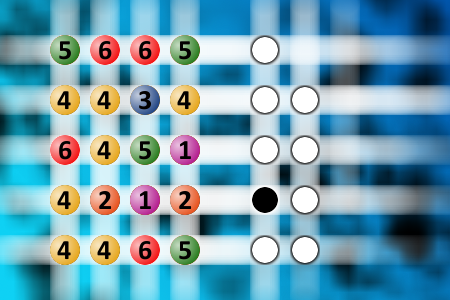
[4772] What a winning combination? - The computer chose a secret code (sequence of 4 digits from 1 to 6). Your goal is to find that code. Black circles indicate the number of hits on the right spot. White circles indicate the number of hits on the wrong spot. - #brainteasers #mastermind - Correct Answers: 40 - The first user who solved this task is Djordje Timotijevic
BRAIN TEASERS
enter your answer and press button OK

What a winning combination?

The computer chose a secret code (sequence of 4 digits from 1 to 6). Your goal is to find that code. Black circles indicate the number of hits on the right spot. White circles indicate the number of hits on the wrong spot.
Correct answers: 40
The first user who solved this task is Djordje Timotijevic.
#brainteasers #mastermind
Register with your Google Account and start collecting points.
Check your ranking on list.

An elderly couple had dinner a...

An elderly couple had dinner at another couple's house, and after eating,the wives left the table and went into the kitchen.
The two gentlemen were talking, and one said, "Last night we went out to anew restaurant and it was really great. I would recommend it very highly."
The other man said, "What is the name of the restaurant?"
The first man thought and thought and finally said, "What is the name ofthat flower you give to someone you love? You know... the one that's red andhas thorns."
"Do you mean a rose?"
"Yes, that's the one," replied the man. He then turned towards the kitchenand yelled, "Rose, what's the name of that restaurant we went to lastnight?"
Jokes of the day - Daily updated jokes. New jokes every day.
Follow Brain Teasers on social networks

Brain Teasers

puzzles, riddles, mathematical problems, mastermind, cinemania...

Ross Granville Harrison

Born 13 Jan 1870; died 30 Sep 1959 at age 89.American zoologist who developed the first successful animal-tissue cultures and pioneered organ transplantation techniques. In an early experiment, using tissue grafting techniques, he joined parts of embryos from differently coloured frogs to observe the movement of cells during the subsequent development of the embryos produced in this way. In another experiment, he took tissue from an amphibian embryo that would have formed a left limb, inverted and transferred it to the embryo's right side, where it formed a right limb. He discovered the hanging-drop culture method (1907), a new method of studying cells, by which he kept fragments of living tissue alive in suitable media and watch them multiply. Using this technique, he settled a controversy about the embryonic origins of nerve fibres. The hanging-drop method has also been valuable in oncology, genetics, virology and other fields.
This site uses cookies to store information on your computer. Some are essential to help the site properly. Others give us insight into how the site is used and help us to optimize the user experience. See our privacy policy.