What a winning combination?
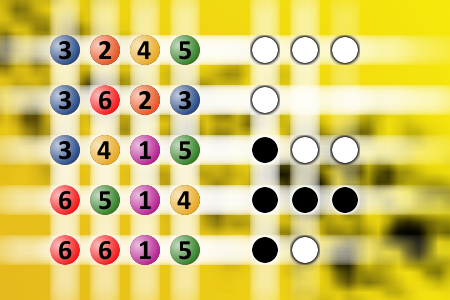
[5075] What a winning combination? - The computer chose a secret code (sequence of 4 digits from 1 to 6). Your goal is to find that code. Black circles indicate the number of hits on the right spot. White circles indicate the number of hits on the wrong spot. - #brainteasers #mastermind - Correct Answers: 42 - The first user who solved this task is Djordje Timotijevic
BRAIN TEASERS
enter your answer and press button OK

What a winning combination?

The computer chose a secret code (sequence of 4 digits from 1 to 6). Your goal is to find that code. Black circles indicate the number of hits on the right spot. White circles indicate the number of hits on the wrong spot.
Correct answers: 42
The first user who solved this task is Djordje Timotijevic.
#brainteasers #mastermind
Register with your Google Account and start collecting points.
Check your ranking on list.

World Book and Copyright Day Joke

April 23rd is World Book and Copyright Day! Find a joke about it!

A man walks into a library and asks the librarian, "Do you have any books on how to create suspense?"
The librarian pauses for a moment, then says, "Yes, but I'm not going to tell you where they are!"

#worldbookandcopyrightday

Jokes of the day - Daily updated jokes. New jokes every day.
Follow Brain Teasers on social networks

Brain Teasers

puzzles, riddles, mathematical problems, mastermind, cinemania...

Mars probe

In 1971, the U.S. Mars space probe Mariner 9 blasted off from Cape Kennedy, Florida. It carried cameras, infrared spectrometer and radiometer, ultraviolet spectrometer, radio occultation and celestial mechanics instruments. On 13 Nov 1971, it entered orbit as the first artificial satellite of Mars. After waiting for a month-long planet-wide dust storm to clear, it began compiling a global mosaic of high-quality images for 100% of the Martian surface. The photos showed gigantic volcanoes, a grand canyon stretching 4,800 kilometers (3,000 miles) and relics of ancient riverbeds that were carved in the landscape of this seemingly dry and dusty planet. It also sent the first closeup pictures of the two Martian moons, Phobos and Deimos.
This site uses cookies to store information on your computer. Some are essential to help the site properly. Others give us insight into how the site is used and help us to optimize the user experience. See our privacy policy.