What a winning combination?
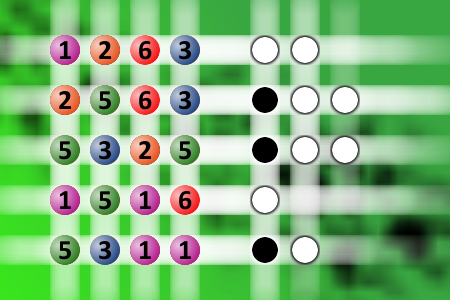
[5663] What a winning combination? - The computer chose a secret code (sequence of 4 digits from 1 to 6). Your goal is to find that code. Black circles indicate the number of hits on the right spot. White circles indicate the number of hits on the wrong spot. - #brainteasers #mastermind - Correct Answers: 45 - The first user who solved this task is Nílton Corrêa De Sousa
BRAIN TEASERS
enter your answer and press button OK

What a winning combination?

The computer chose a secret code (sequence of 4 digits from 1 to 6). Your goal is to find that code. Black circles indicate the number of hits on the right spot. White circles indicate the number of hits on the wrong spot.
Correct answers: 45
The first user who solved this task is Nílton Corrêa De Sousa.
#brainteasers #mastermind
Register with your Google Account and start collecting points.
Check your ranking on list.

What Nationality Were Adam and Eve?

A Briton, a Frenchman and a Russian are viewing a painting of Adam and Eve frolicking in the Garden of Eden. "Look at their reserve, their calm," muses the Brit. "They must be British." "Nonsense," the Frenchman disagrees. "They're naked, and so beautiful. Clearly, they are French." "No clothes, no shelter," the Russian points out, "they have only an apple to eat, and they're being told this is paradise. They are Russian."
Jokes of the day - Daily updated jokes. New jokes every day.
Follow Brain Teasers on social networks

Brain Teasers

puzzles, riddles, mathematical problems, mastermind, cinemania...

Vitamin C

In 1932, Professor C. Glen King of the University of Pittsburgh isolated vitamin C, a medical and scientific breakthrough, after five years of effort. By painstaking research extracting components from lemon juice - requiring untold thousands of lemons - King and his colleagues isolated a crystalline substance, identified, and later synthesized vitamin C. Their discovery meant prevention of the disease of scurvy, long a source of human suffering. During WW II, King was named chairman of the Nutrition Foundation, which funded research into the nutritional problems facing a country and an army at war. He continued his innovative work with vitamin C until his retirement from Columbia University in 1964.
This site uses cookies to store information on your computer. Some are essential to help the site properly. Others give us insight into how the site is used and help us to optimize the user experience. See our privacy policy.