What a winning combination?
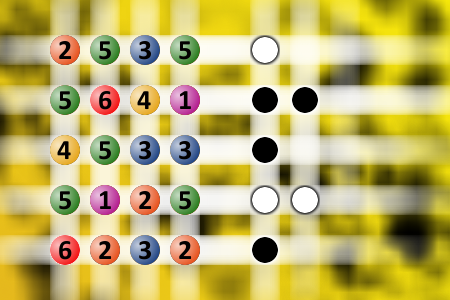
[5901] What a winning combination? - The computer chose a secret code (sequence of 4 digits from 1 to 6). Your goal is to find that code. Black circles indicate the number of hits on the right spot. White circles indicate the number of hits on the wrong spot. - #brainteasers #mastermind - Correct Answers: 25 - The first user who solved this task is Nasrin 24 T
BRAIN TEASERS
enter your answer and press button OK

What a winning combination?

The computer chose a secret code (sequence of 4 digits from 1 to 6). Your goal is to find that code. Black circles indicate the number of hits on the right spot. White circles indicate the number of hits on the wrong spot.
Correct answers: 25
The first user who solved this task is Nasrin 24 T.
#brainteasers #mastermind
Register with your Google Account and start collecting points.
Check your ranking on list.

McPherson walked into a bar an...

McPherson walked into a bar and ordered martini after martini, each time removing the olives and placing them in a jar. When the jar was filled with olives and all the drinks consumed, the Irishman started to leave.
"Excuse me," said another bar patron, who was puzzled over what McPherson had done. "What was that all about?"
"Nothing," said the Irishman, "my wife sent me out for a jar of olives."
Jokes of the day - Daily updated jokes. New jokes every day.
Follow Brain Teasers on social networks

Brain Teasers

puzzles, riddles, mathematical problems, mastermind, cinemania...

Lewis Henry Morgan

Died 17 Dec 1881 at age 63 (born 21 Nov 1818).American ethnologist and a principal founder of scientific anthropology, known especially for establishing the study of kinship systems and for his comprehensive theory of social evolution. Morgan discovered that the Indians in North America had some kinship patterns in common with each other. He was the first person to classify the kinship system of relationship in The Indian Journals (1859-62). Morgan's work was the foundation for the new world view of genetic explanation, cultural evolution or social Darwinism, in Houses and House-life of the American Aborigines (1865). He also brought to the people's attention the organization of the ancient Greeks and Romans was the same as the clan organization of the Indian tribes.
This site uses cookies to store information on your computer. Some are essential to help the site properly. Others give us insight into how the site is used and help us to optimize the user experience. See our privacy policy.