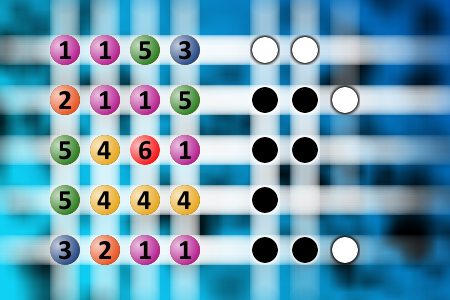
What a winning combination?
The computer chose a secret code (sequence of 4 digits from 1 to 6). Your goal is to find that code. Black circles indicate the number of hits on the right spot. White circles indicate the number of hits on the wrong spot.Correct answers: 24
The first user who solved this task is Nílton Corrêa De Sousa.
#brainteasers #mastermind

An Englishman, a Scotsman, and...
An Englishman, a Scotsman, and an Irishman are all to give speeches to the Deaf Society. All are keen to make an impression on their audience.
The Englishman goes first and to the surprise of his colleagues starts by rubbing first his chest and then his groin.
When he finishes the Scotsman and Irishman ask him what he was doing. "Well," he explained, "by rubbing my chest I indicated breasts and thus Ladies and by rubbing my groin I indicated balls and thus Gentlemen. So my speech started 'Ladies and Gentlemen'".
On his way up to the podium the Scotsman thought to himself "I'll go one better than that English bastard", and started his speech by making an antler symbol with his fingers above his head before also rubbing his chest and his groin.
When he finished his colleagues asked what he was doing. "Well," he explained, "by imitating antlers and then rubbing my chest and groin I was starting my speech by saying 'Dear Ladies and Gentlemen'".
On his way up to the podium the Irishman thought to himself "I'll go one further than those mainland bastards", and started his speech by making an antler symbol above his head, rubbing his chest, and then his groin, and then masturbating furiously.
When he finished his colleagues asked him what he was doing. "Well," he explained, "by imitating antlers, rubbing my chest and then my groin and then masturbating I was starting my speech by saying 'Deer Ladies and Gentlemen, it gives me great pleasure...'"
The Englishman goes first and to the surprise of his colleagues starts by rubbing first his chest and then his groin.
When he finishes the Scotsman and Irishman ask him what he was doing. "Well," he explained, "by rubbing my chest I indicated breasts and thus Ladies and by rubbing my groin I indicated balls and thus Gentlemen. So my speech started 'Ladies and Gentlemen'".
On his way up to the podium the Scotsman thought to himself "I'll go one better than that English bastard", and started his speech by making an antler symbol with his fingers above his head before also rubbing his chest and his groin.
When he finished his colleagues asked what he was doing. "Well," he explained, "by imitating antlers and then rubbing my chest and groin I was starting my speech by saying 'Dear Ladies and Gentlemen'".
On his way up to the podium the Irishman thought to himself "I'll go one further than those mainland bastards", and started his speech by making an antler symbol above his head, rubbing his chest, and then his groin, and then masturbating furiously.
When he finished his colleagues asked him what he was doing. "Well," he explained, "by imitating antlers, rubbing my chest and then my groin and then masturbating I was starting my speech by saying 'Deer Ladies and Gentlemen, it gives me great pleasure...'"