What a winning combination?
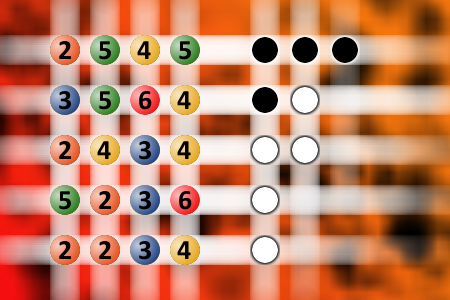
[6147] What a winning combination? - The computer chose a secret code (sequence of 4 digits from 1 to 6). Your goal is to find that code. Black circles indicate the number of hits on the right spot. White circles indicate the number of hits on the wrong spot. - #brainteasers #mastermind - Correct Answers: 26 - The first user who solved this task is Nasrin 24 T
BRAIN TEASERS
enter your answer and press button OK

What a winning combination?

The computer chose a secret code (sequence of 4 digits from 1 to 6). Your goal is to find that code. Black circles indicate the number of hits on the right spot. White circles indicate the number of hits on the wrong spot.
Correct answers: 26
The first user who solved this task is Nasrin 24 T.
#brainteasers #mastermind
Register with your Google Account and start collecting points.
Check your ranking on list.

What day is it?

Over breakfast one morning, a woman said to her husband, "I bet you don't know what day this is."

"Of course I do," he indignantly answered, getting up from the table and going out the door to the office.

At 10am, the doorbell rang. When the woman opened the door, she was handed a box containing a dozen long-stemmed red roses. At 1pm, a foil-wrapped, two-pound box of her favorite chocolates arrived. Later, a boutique delivered a designer dress.

The woman couldn't wait for her husband to come home. When he did, she exclaimed, "First the flowers, then the chocolates and then the dress! I've never had a more wonderful Groundhog Day in my life!"

Jokes of the day - Daily updated jokes. New jokes every day.
Follow Brain Teasers on social networks

Brain Teasers

puzzles, riddles, mathematical problems, mastermind, cinemania...

Paul Alfred Weiss

Born 21 Mar 1898; died 8 Sep 1989 at age 91.Austrian-American biologist who researched nerve regeneration, wound healing and the mechanics of nerve development. During World War II Weiss and his colleagues developed and tested the first practical system of preserving human tissue for later surgical grafting. His experiments on growth and development of neuronal cells led to a study of inductive interactions between tissues as contact effects. Further, he investigated organ-specific antibodies as possible catalysts in growth and differentiation of the respective organs caused by a cooperative product of cell and cell matrix interaction
This site uses cookies to store information on your computer. Some are essential to help the site properly. Others give us insight into how the site is used and help us to optimize the user experience. See our privacy policy.