What a winning combination?
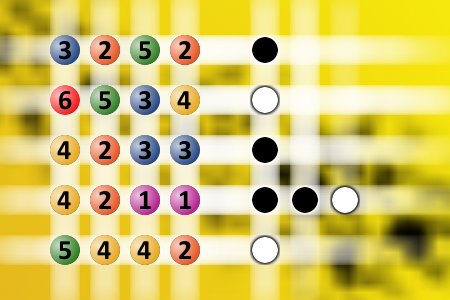
[6576] What a winning combination? - The computer chose a secret code (sequence of 4 digits from 1 to 6). Your goal is to find that code. Black circles indicate the number of hits on the right spot. White circles indicate the number of hits on the wrong spot. - #brainteasers #mastermind - Correct Answers: 21 - The first user who solved this task is Nasrin 24 T
BRAIN TEASERS
enter your answer and press button OK

What a winning combination?

The computer chose a secret code (sequence of 4 digits from 1 to 6). Your goal is to find that code. Black circles indicate the number of hits on the right spot. White circles indicate the number of hits on the wrong spot.
Correct answers: 21
The first user who solved this task is Nasrin 24 T.
#brainteasers #mastermind
Register with your Google Account and start collecting points.
Check your ranking on list.

Blessing a Body…?

A newly ordained deacon was asked to hold a graveside service for someone with no family or friends. It was his first official assignment, so he eagerly agreed.Taking his duties very seriously, the deacon let early the next morning for the cemetery. However, he made several wrong turns and quickly got himself lost. When he finally arrived more than an hour late, the hearse was nowhere to be seen and the two workmen were eating lunch.The deacon got out of his car, quickly threw on his vestments, and hurried to the open grave. Looking into the pit, he saw that the vault lid was already in place. With a sign, he took out his prayer book and read the burial service. After he had left, one of the workmen said to the other, “Maybe we should have told him he just blessed a septic tank.”
Jokes of the day - Daily updated jokes. New jokes every day.
Follow Brain Teasers on social networks

Brain Teasers

puzzles, riddles, mathematical problems, mastermind, cinemania...

J. Georg Bednorz

Born 16 May 1950.Johannes Georg Bednorz is a German physicist who shared the 1987 Nobel Prize for Physics (with Karl Alex Müller) for their joint discovery of superconductivity in a new class of materials at temperatures higher than had previously been thought attainable. They startled the world by reporting superconductivity in a layered, ceramic material at a then record-high temperature of 33 kelvin (that is 33 degrees above absolute zero, or roughly -460 degrees Fahrenheit). Their discovery set off an avalanche of research worldwide into related materials that yielded dozens of new superconductors, eventually reaching a transition temperature of 135 kelvin. Today, he develops complex oxide compounds with novel crystal structures for possible uses in microelectronics.
This site uses cookies to store information on your computer. Some are essential to help the site properly. Others give us insight into how the site is used and help us to optimize the user experience. See our privacy policy.