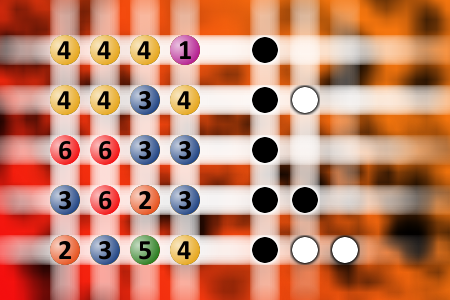
What a winning combination?
[6954] What a winning combination? - The computer chose a secret code (sequence of 4 digits from 1 to 6). Your goal is to find that code. Black circles indicate the number of hits on the right spot. White circles indicate the number of hits on the wrong spot. - #brainteasers #mastermind - Correct Answers: 17 - The first user who solved this task is Nasrin 24 T
BRAIN TEASERS
enter your answer and press button OK

What a winning combination?

The computer chose a secret code (sequence of 4 digits from 1 to 6). Your goal is to find that code. Black circles indicate the number of hits on the right spot. White circles indicate the number of hits on the wrong spot.
Correct answers: 17
The first user who solved this task is Nasrin 24 T.
#brainteasers #mastermind
Register with your Google Account and start collecting points.
Check your ranking on list.

Little Johnny is taking a show...

Little Johnny is taking a shower with his mother and says, "Mom, what are those things on your chest!?" Unsure of how to reply, she tells Johnny to ask his dad at breakfast tomorrow, quite certain the matter would be forgotten.

Johnny didn't forget. The following morning he asked his father the same question. His father, always quick with the answers, says, "Why Johnny, those are balloons. When your mommy dies, we can blow them up and she'll float to heaven." Johnny thinks that's neat and asks no more questions.

A few weeks later, Johnnys' dad comes home from work a few hours early. Johnny runs out of the house crying hysterically, "Daddy! Daddy! Mommy's dying!!"

His father says, "Calm down son! Why do you think Mommy's dying?"

"Uncle Harry is blowing up Mommys' balloons and she's screaming, "Oh God, I'm coming!"
Jokes of the day - Daily updated jokes. New jokes every day.
Follow Brain Teasers on social networks

Brain Teasers

puzzles, riddles, mathematical problems, mastermind, cinemania...

Ilya Prigogine

Born 25 Jan 1917; died 28 May 2003 at age 86. Russian-born Belgian physical chemist who received the Nobel Prize for Chemistry in 1977 for contributions to nonequilibrium thermodynamics, or how life could continue indefinitely in apparent defiance of the classical laws of physics. The main theme of Prigogine's work was the search for a better understanding of the role of time in the physical sciences and in biology. He attempted to reconcile a tendency in nature for disorder to increase (for statues to crumble or ice cubes to melt, as described in the second law of thermodynamics) with so-called "self-organisation", a countervailing tendency to create order from disorder (as seen in, for example, the formation of the complex proteins in a living creature from a mixture of simple molecules).
This site uses cookies to store information on your computer. Some are essential to help the site properly. Others give us insight into how the site is used and help us to optimize the user experience. See our privacy policy.