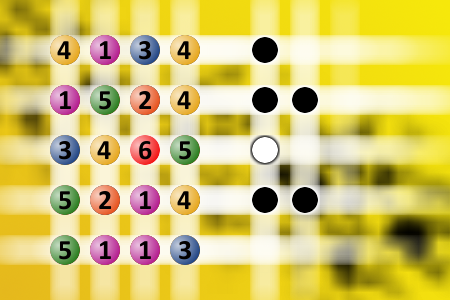
What a winning combination?
[6963] What a winning combination? - The computer chose a secret code (sequence of 4 digits from 1 to 6). Your goal is to find that code. Black circles indicate the number of hits on the right spot. White circles indicate the number of hits on the wrong spot. - #brainteasers #mastermind - Correct Answers: 21 - The first user who solved this task is Nasrin 24 T
BRAIN TEASERS
enter your answer and press button OK

What a winning combination?

The computer chose a secret code (sequence of 4 digits from 1 to 6). Your goal is to find that code. Black circles indicate the number of hits on the right spot. White circles indicate the number of hits on the wrong spot.
Correct answers: 21
The first user who solved this task is Nasrin 24 T.
#brainteasers #mastermind
Register with your Google Account and start collecting points.
Check your ranking on list.

After working most of her life...

After working most of her life Grandma finally retired. At her nextcheckup, the new doctor told her to bring a list of all the medicinesthat had been prescribed for her.
As the young doctor was looking through these, his eyes grew wide as herealized she had a prescription for birth control pills. "Mrs. Smith, doyou realize these are BIRTH CONTROL pills?"
Yes, they help me sleep at night. "
"Mrs. Smith, I assure you there is absolutely NOTHING in thesethat could possibly help you sleep!
She reached out and patted the young Doctor's knee. "Yes, dear,I knowthat. But every morning, I grind one up and mix it in the glass oforange juice that my 16 year old granddaughter drinks . . . and believeme, it helps me sleep at night. "
You gotta love Grandmas!
Jokes of the day - Daily updated jokes. New jokes every day.
Follow Brain Teasers on social networks

Brain Teasers

puzzles, riddles, mathematical problems, mastermind, cinemania...

Player piano

In 1881, a patent was issued for his invention of a piano player to John McTammany, Jr., of Cambridge, Mass. He had earlier filed a caveat on 7 Sep 1876. His patent descibed his "mechanical mucical instrument" as a mechanism for automatic playing of organs using narrow sheets of perforated flexible paper which governed the notes to be played. The first completely automatic piano player to be manufactured in the U.S. was the Angelus made in Feb 1897, which was patented by its inventor, Edward H. Leveaux, in England on 27 Feb 1879, and who was issued a U.S. patent on 4 Oct 1881 for an "apparatus for storing and transmitting motive power."
This site uses cookies to store information on your computer. Some are essential to help the site properly. Others give us insight into how the site is used and help us to optimize the user experience. See our privacy policy.