What a winning combination?
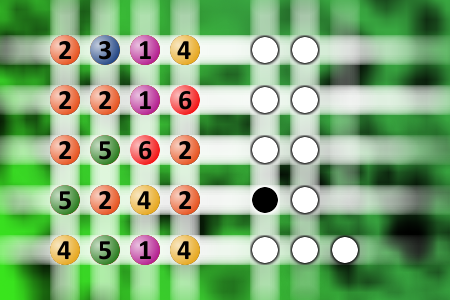
[7278] What a winning combination? - The computer chose a secret code (sequence of 4 digits from 1 to 6). Your goal is to find that code. Black circles indicate the number of hits on the right spot. White circles indicate the number of hits on the wrong spot. - #brainteasers #mastermind - Correct Answers: 6
BRAIN TEASERS
enter your answer and press button OK

What a winning combination?

The computer chose a secret code (sequence of 4 digits from 1 to 6). Your goal is to find that code. Black circles indicate the number of hits on the right spot. White circles indicate the number of hits on the wrong spot.
Correct answers: 6
#brainteasers #mastermind
Register with your Google Account and start collecting points.
Check your ranking on list.

A beautiful, voluptuous woman...

A beautiful, voluptuous woman went to a gynecologist.
The doctor took one look at this woman and all his professionalism went out the window. He immediately told her to undress.
After she had disrobed the doctor began to stroke her thigh. Doing so, he asked her, "Do you know what I'm doing?"
"Yes," she replied, "you're checking for any abrasions or dermatological abnormalities."
"That is right," said the doctor.
He then began to fondle her breasts. "Do you know what I'm doing now?" he asked.
"Yes," the woman said, "you're checking for any lumps or breast cancer."
"Correct," replied the shady doctor.
Finally, he mounted his patient and started having sexual intercourse with her. He asked, "Do you know what I'm doing now?"
"Yes," she said. "You're getting herpes; which is why I came here in the first place."
Jokes of the day - Daily updated jokes. New jokes every day.
Follow Brain Teasers on social networks

Brain Teasers

puzzles, riddles, mathematical problems, mastermind, cinemania...

Coaxial cable

In 1931, the invention of coaxial cable was issued a U.S. patent for the first time in the U.S., described as a "concentric conducting system". The inventors were Lloyd Espenschied of Kew Gardens, N.Y. and Herman A. Affel of Ridgewood, N.J. The patent was assigned to the American Telegraph and Telephone Co. of New York City. (No. 1,835,031). The application was television, for which a wide range of transmision frequencies is required. Whereas individual channel requirements for telegraphy are of the order of a few hundred cycles at most, and telephony perhaps a few thousand cycles, television requires bands of hundreds of thousands of cycles in width to ensure a reasonable degree of picture detail. A single pair concentric conductor arrangement is used.
This site uses cookies to store information on your computer. Some are essential to help the site properly. Others give us insight into how the site is used and help us to optimize the user experience. See our privacy policy.