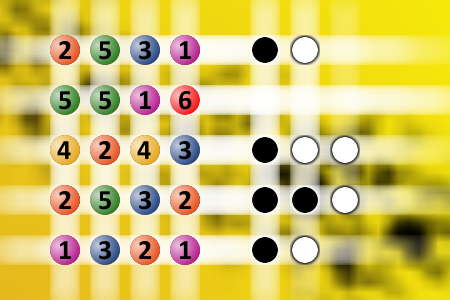
What a winning combination?
[7296] What a winning combination? - The computer chose a secret code (sequence of 4 digits from 1 to 6). Your goal is to find that code. Black circles indicate the number of hits on the right spot. White circles indicate the number of hits on the wrong spot. - #brainteasers #mastermind - Correct Answers: 10
BRAIN TEASERS
enter your answer and press button OK

What a winning combination?

The computer chose a secret code (sequence of 4 digits from 1 to 6). Your goal is to find that code. Black circles indicate the number of hits on the right spot. White circles indicate the number of hits on the wrong spot.
Correct answers: 10
#brainteasers #mastermind
Register with your Google Account and start collecting points.
Check your ranking on list.

World Cotton Day Jokes

On 7th October it's World Cotton Day! Let's have some cotton-themed humor:

I’m allergic to cotton
I would take medicine for it, but I can’t get it out of the bottle

I told my kids I was gonna take them to that place with the Ferris wheel and cotton candy, but instead I took them to the dentist
They said it wasn’t fair

My teacher in workshop laughed when I said I could make a deadly knife out of cotton...
...After I sharpened the tip, he backed down saying, "I see you've made your point."

"Why is that cotton candy talking?"
"Grandma, that's Nicki Minaj"

Scientists have created a cotton plant resistant to boll weevils.
When asked about it, they replied, "It's unbollweevible."

#worldcottonday
Jokes of the day - Daily updated jokes. New jokes every day.
Follow Brain Teasers on social networks

Brain Teasers

puzzles, riddles, mathematical problems, mastermind, cinemania...

Alfred Wolf

Died 17 Dec 1998 at age 75 (born 13 Feb 1923).Alfred Peter Wolf was an American nuclear and organic chemist. As a senior chemist at the U.S. Brookhaven National Laboratory, he made pioneering contributions over nearly 50 years in the field of organic radiochemistry. By the mid-1960's, his fundamental studies in the synthesis of small, radiolabeled compounds grew into a new interest in developing radiotracers labeled with short-lived positron emitting isotopes like carbon-11 so that the tracer method could be applied to visualize biochemical transformations in living systems. His discoveries led to advances in medical imaging, especially the development of positron emission tomography, or PET, a tool now used worldwide to diagnose disease and study the brain's inner workings.
This site uses cookies to store information on your computer. Some are essential to help the site properly. Others give us insight into how the site is used and help us to optimize the user experience. See our privacy policy.