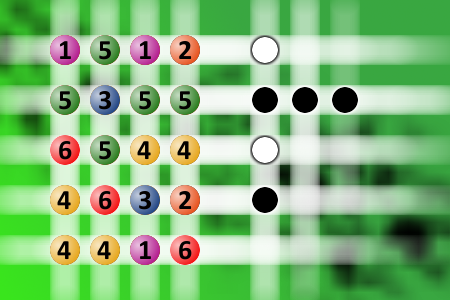
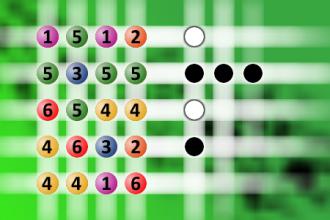
What a winning combination?
[7394] What a winning combination? - The computer chose a secret code (sequence of 4 digits from 1 to 6). Your goal is to find that code. Black circles indicate the number of hits on the right spot. White circles indicate the number of hits on the wrong spot. - #brainteasers #mastermind - Correct Answers: 10
BRAIN TEASERS
enter your answer and press button OK

What a winning combination?

The computer chose a secret code (sequence of 4 digits from 1 to 6). Your goal is to find that code. Black circles indicate the number of hits on the right spot. White circles indicate the number of hits on the wrong spot.
Correct answers: 10
#brainteasers #mastermind
Register with your Google Account and start collecting points.
Check your ranking on list.

New short Jokes to start day with laugh

My local supermarket is exchanging old novels for certain root vegetables.
That's a turnip for the books.

Apparently you can’t use beefstew as a password…
It ain’t stroganoff!

Someone stole my broken calculator, but I don't know why.
It just doesn't add up.

When I was a boy, "The Jetsons" gave me unrealistic expectations about the future
. . . like having a job, a loving family, and a dog.

Not to brag but I made six figures last year
I was also named worst employee at the toy factory

A guy walks into a bar and people start lining up to punch him
Yeah that’s the punchline

How do you get a one armed man out of a tree?
Wave!

Jokes of the day - Daily updated jokes. New jokes every day.
Follow Brain Teasers on social networks

Brain Teasers

puzzles, riddles, mathematical problems, mastermind, cinemania...

A Mind That Found Itself

In 1905, Clifford Beers (1876-1943) commenced his autobiography that became a classic for mental health professionals. As he recordedin his finished book, A Mind That Found Itself, “I began to write. Within two days I had written about fifteen thousand words—for the most part on the subject of reforms and how to effect them.” He had already himself experienced treatment as a mental patient, and he wished to document the appalling conditions and maltreatment by staff in asylums. His unsettled elation upon beginning the work caused his brother to have him committed again, temporarily, to an institution. When the book was eventually published (Mar 1908), he raised the public consciousness and indeed prompted reform in the care of mental patients. By 1921, it had five editions.«
This site uses cookies to store information on your computer. Some are essential to help the site properly. Others give us insight into how the site is used and help us to optimize the user experience. See our privacy policy.