What a winning combination?
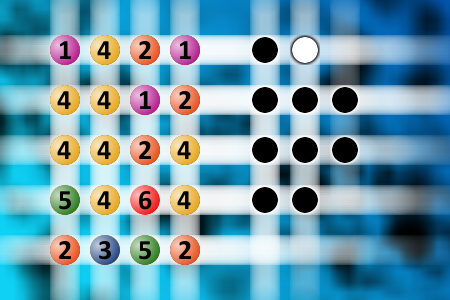
[7449] What a winning combination? - The computer chose a secret code (sequence of 4 digits from 1 to 6). Your goal is to find that code. Black circles indicate the number of hits on the right spot. White circles indicate the number of hits on the wrong spot. - #brainteasers #mastermind - Correct Answers: 7
BRAIN TEASERS
enter your answer and press button OK

What a winning combination?

The computer chose a secret code (sequence of 4 digits from 1 to 6). Your goal is to find that code. Black circles indicate the number of hits on the right spot. White circles indicate the number of hits on the wrong spot.
Correct answers: 7
#brainteasers #mastermind
Register with your Google Account and start collecting points.
Check your ranking on list.

Beer Test

"Yesterday, scientists revealed that beer contains small traces of female hormones.

To prove their theory, the scientists fed 100 men 12 pints of beer and observed that 100% of them gained weight, talked excessively without making sense, became emotional, couldn't drive, and refused to apologize when wrong.

No further testing is planned."

Submitted by Calamjo

Jokes of the day - Daily updated jokes. New jokes every day.
Follow Brain Teasers on social networks

Brain Teasers

puzzles, riddles, mathematical problems, mastermind, cinemania...

Sir C. Wyville Thomson

Born 5 Mar 1830; died 10 Mar 1882 at age 52.Sir C(harles) Wyville Thomson was a Scottish naturalist who was one of the first marine biologists to describe life in the ocean depths. He led the famous 110,224-km (68,890 mile) scientific expedition of HMS Challenger in (1872-6) which trawled the depths of the oceans for new forms of life. This was the world's first foray into big science. The Expedition was to circumnavigate the world in the steam corvette, HMS Challenger, with a goal, as resolved by the British Association (1871) of "carrying the physical and biological Exploration of the deep-sea into all the great oceanic centres". The extensive biological collections, together with soundings, bottom samples, and chemical and physical observations, presented the first broad view of the character of the oceans.
This site uses cookies to store information on your computer. Some are essential to help the site properly. Others give us insight into how the site is used and help us to optimize the user experience. See our privacy policy.