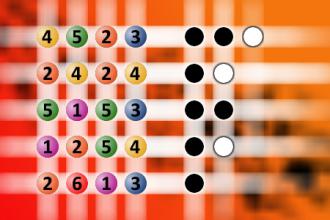
What a winning combination?
[7599] What a winning combination? - The computer chose a secret code (sequence of 4 digits from 1 to 6). Your goal is to find that code. Black circles indicate the number of hits on the right spot. White circles indicate the number of hits on the wrong spot. - #brainteasers #mastermind - Correct Answers: 4
BRAIN TEASERS
enter your answer and press button OK

What a winning combination?

The computer chose a secret code (sequence of 4 digits from 1 to 6). Your goal is to find that code. Black circles indicate the number of hits on the right spot. White circles indicate the number of hits on the wrong spot.
Correct answers: 4
#brainteasers #mastermind
Register with your Google Account and start collecting points.
Check your ranking on list.

There was a man walking alone ...

There was a man walking alone along a beach. He comes across a bottle with a cork in it. The man picks up the bottle and pulls out the cork. A loud roar follows and a genie appears. The genie says to the man, "I'm a little tired today and I can only give you two wishes."
The man says "That's OK, two is enough." "First, I would like one-billion dollars in a Swiss bank account."
Poof - The genie hands the man a paper and says "Here's the number to your account."
Next the man says, "Second, I would like to be irresistible to women."
Poof - the genie turned him into a box of chocolates.
Jokes of the day - Daily updated jokes. New jokes every day.
Follow Brain Teasers on social networks

Brain Teasers

puzzles, riddles, mathematical problems, mastermind, cinemania...

George Henry Falkiner Nuttall

Died 16 Dec 1937 at age 75 (born 5 Jul 1862).American-born British biologist and physician who contributed substantially to many branches of biology and founded the Molteno Institute of Biology and Parasitology (1921) at the University of Cambridge. He was interested in parasitology and the role of insects and other disease vectors, making studies of immunity reactions and the bacteriology of diptheria. He carried out investigations of the distribution of Anopheline mosquitoes in England in relation to the previous prevalence of malaria there in addition to working on blood precipition reactions.
This site uses cookies to store information on your computer. Some are essential to help the site properly. Others give us insight into how the site is used and help us to optimize the user experience. See our privacy policy.