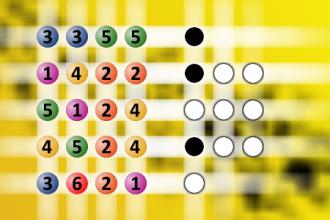
What a winning combination?
[7617] What a winning combination? - The computer chose a secret code (sequence of 4 digits from 1 to 6). Your goal is to find that code. Black circles indicate the number of hits on the right spot. White circles indicate the number of hits on the wrong spot. - #brainteasers #mastermind - Correct Answers: 5
BRAIN TEASERS
enter your answer and press button OK

What a winning combination?

The computer chose a secret code (sequence of 4 digits from 1 to 6). Your goal is to find that code. Black circles indicate the number of hits on the right spot. White circles indicate the number of hits on the wrong spot.
Correct answers: 5
#brainteasers #mastermind
Register with your Google Account and start collecting points.
Check your ranking on list.

A group of third, fourth and f...

A group of third, fourth and fifth graders accompanied by two female teachers went on a field trip to the local racetrack to learn about thoroughbred horses and the supporting industry.
During the tour some of the children wanted to go to the toilet so it was decided that the girls would go with one teacher and the boys would go with the other.
As the teacher assigned to the boys waited outside the men's toilet, one of the boys came out and told her he couldn't reach the urinal. Having no choice, she went inside and began hoisting the little boys up by their armpits, one by one.
As she lifted one, she couldn't help but notice that he was unusually well endowed for an elementary school child.
"I guess you must be in the fifth," she said.
"No ma'am," he replied, "I'm in the seventh, riding Silver Arrow. Thanks for the lift anyhow."
Jokes of the day - Daily updated jokes. New jokes every day.
Follow Brain Teasers on social networks

Brain Teasers

puzzles, riddles, mathematical problems, mastermind, cinemania...

Charles Babbage

Born 26 Dec 1791; died 18 Oct 1871 at age 79. English mathematician who was a pioneer of mechanical computation, which he pursued to eliminate inaccuracies in mathematical tables. By 1822, he had a small calculating machine able to compute squares. He produced prototypes of portions of a larger Difference Engine. (Georg and Edvard Schuetz later constructed the first working devices to the same design which were successful in limited applications.) In 1833 he began his programmable Analytical Machine, a forerunner of modern computers. His other inventions include the cowcatcher, dynamometer, standard railroad gauge, uniform postal rates, occulting lights for lighthouses, Greenwich time signals, heliograph opthalmoscope. He also had an interest in cyphers and lock-picking.«[EB gives birth date 26 Dec 1791.DSB gives birth date as 26 Dec 1792.]
This site uses cookies to store information on your computer. Some are essential to help the site properly. Others give us insight into how the site is used and help us to optimize the user experience. See our privacy policy.