What a winning combination?
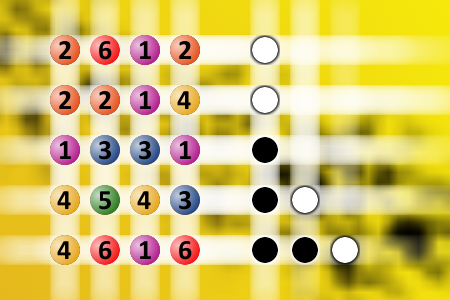
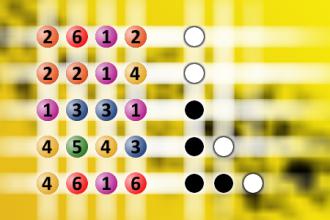
[7658] What a winning combination? - The computer chose a secret code (sequence of 4 digits from 1 to 6). Your goal is to find that code. Black circles indicate the number of hits on the right spot. White circles indicate the number of hits on the wrong spot. - #brainteasers #mastermind - Correct Answers: 3
BRAIN TEASERS
enter your answer and press button OK

What a winning combination?

The computer chose a secret code (sequence of 4 digits from 1 to 6). Your goal is to find that code. Black circles indicate the number of hits on the right spot. White circles indicate the number of hits on the wrong spot.
Correct answers: 3
#brainteasers #mastermind

Register with your Google Account and start collecting points.
Check your ranking on list.

Jessi Klein: Sexy Librarian

I have brown hair and I wear these glasses, and I usually have my hair up in a bun, so the other thing guys have often said to me is, Youre like a sexy librarian. Youre like a sexy librarian type. Youre a sexy librarian. And Im like, Ive always thought of myself as more of a bookish whore. Sort of, you know, less of a nerd, more of a slut.
Jokes of the day - Daily updated jokes. New jokes every day.
Follow Brain Teasers on social networks

Brain Teasers

puzzles, riddles, mathematical problems, mastermind, cinemania...

Walter Baade

Born 24 Mar 1893; died 25 Jun 1960 at age 67. German-American astronomer who, with Fritz Zwicky, proposed that supernovae could produce cosmic rays and neutron stars (1934), and Baade made extensive studies of the Crab Nebula and its central star. During WW II blackouts of the Los Angeles area Baade used the 100-inch Hooker telescope to resolve stars in the central region of the Andromeda Galaxy for the first time. This led to his definition of two stellar populations, to the realization that there were two kinds of Cepheid variable stars, and from there to a doubling of the assumed scale of the universe. Baade and Rudolph Minkowski identified and took spectrograms of optical counterparts of many of the first-discovered radio sources, including Cygnus A and Cassiopeia A.
This site uses cookies to store information on your computer. Some are essential to help the site properly. Others give us insight into how the site is used and help us to optimize the user experience. See our privacy policy.