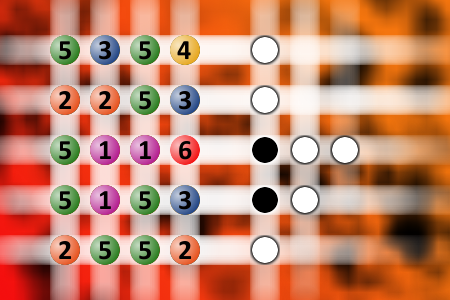
What a winning combination?
[7751] What a winning combination? - The computer chose a secret code (sequence of 4 digits from 1 to 6). Your goal is to find that code. Black circles indicate the number of hits on the right spot. White circles indicate the number of hits on the wrong spot. - #brainteasers #mastermind - Correct Answers: 2
BRAIN TEASERS
enter your answer and press button OK

What a winning combination?

The computer chose a secret code (sequence of 4 digits from 1 to 6). Your goal is to find that code. Black circles indicate the number of hits on the right spot. White circles indicate the number of hits on the wrong spot.
Correct answers: 2
#brainteasers #mastermind
Register with your Google Account and start collecting points.
Check your ranking on list.

There was once a blonde woman...

There was once a blonde woman on a plane to Detroit. She was in the economy class, but after takeoff, she saw an empty seat in first class and moved there. An attendant saw her and said, "Excuse me, ma'am, but you have a ticket for economy class, not first. You cannot stay here." The blonde replied, "I can and I will." The attendant told the copilot, who came and talked to the woman. "Ma'am, we really can't have you staying in this seat, your ticket was for economy." "You can't make me move." The copilot told the captain, who tried to talk her out of the seat but it didn't work. Finally, a man who had heard what had been going on told the attendant to let him have a go at getting the woman out of the seat because he was married to a blonde too, so he knew how to deal with her. After a quick chat with her, she moved. The shocked attendant asked him how he did it. The man replied, "I told her first class wasn't going to Detroit."
Jokes of the day - Daily updated jokes. New jokes every day.
Follow Brain Teasers on social networks

Brain Teasers

puzzles, riddles, mathematical problems, mastermind, cinemania...

Joseph Erlanger

Died 5 Dec 1965 at age 91 (born 5 Jan 1874).American physiologist who discovered that fibres within the same nerve cord possess different functions. In 1910 he accepted the chair of physiology at Washington University in St. Louis, which he held until his retirement in 1946. While his department became one of the major research centers in physiology in America. Erlanger continued his work on cardiovascular physiology. During WW I, he carried out research on the problem of shock. In 1921 he shifted his interests to neurophysiology, and began joint work, with colleague Herbert Gasser, on the amplification and recording of nerve action potentials with the cathode ray oscilloscope, for which they were awarded the Nobel Prize for Physiology or Medicine in 1944.
This site uses cookies to store information on your computer. Some are essential to help the site properly. Others give us insight into how the site is used and help us to optimize the user experience. See our privacy policy.