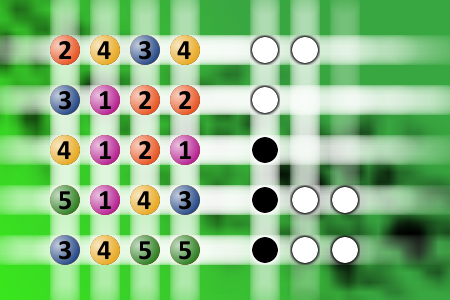

What a winning combination?
[8464] What a winning combination? - The computer chose a secret code (sequence of 4 digits from 1 to 6). Your goal is to find that code. Black circles indicate the number of hits on the right spot. White circles indicate the number of hits on the wrong spot. - #brainteasers #mastermind - Correct Answers: 0
BRAIN TEASERS
enter your answer and press button OK

What a winning combination?

The computer chose a secret code (sequence of 4 digits from 1 to 6). Your goal is to find that code. Black circles indicate the number of hits on the right spot. White circles indicate the number of hits on the wrong spot.
Correct answers: 0
#brainteasers #mastermind
Register with your Google Account and start collecting points.
Check your ranking on list.

Fertilizer

A farmer was driving along the road with a load of fertilizer. A little boy, playing in front of his house, saw him and called, "What've you got in your truck?"

"Fertilizer," the farmer replied.

"What are you going to do with it?" asked the little boy.

"Put it on strawberries," answered the farmer.

"You ought to live here," the little boy advised him. "We put sugar and cream on ours."

Jokes of the day - Daily updated jokes. New jokes every day.
Follow Brain Teasers on social networks

Brain Teasers

puzzles, riddles, mathematical problems, mastermind, cinemania...

Sir Henry Bessemer

Died 15 Mar 1898 at age 85 (born 19 Jan 1813). English industrialist, metallurgist, inventor and engineer who developed the first process for manufacturing steel inexpensively (1856), leading to the development of the Bessemer converter. Bessemer invented his steel making process to solve a specific problem vexing another of his inventions, the self-spinning artillery shell. The converter removed impurities from molten pig iron by oxidation through air being blown through the molten iron. The oxidation also raised the temperature of the iron mass, keeping it molten. The oxidation process removed impurities such as silicon, manganese, and carbon as oxides, which oxides either escapd as gas or formed a solid slag. He also solved problems about the chemistry of ores, fuels, and steel. He held 110 patents at his death.
This site uses cookies to store information on your computer. Some are essential to help the site properly. Others give us insight into how the site is used and help us to optimize the user experience. See our privacy policy.