What can you put in a wood b...
[3273] What can you put in a wood b... - What can you put in a wood box that will make it lighter? - #brainteasers #riddles - Correct Answers: 73 - The first user who solved this task is Snezana Milanovic
BRAIN TEASERS
enter your answer and press button OK

What can you put in a wood b...

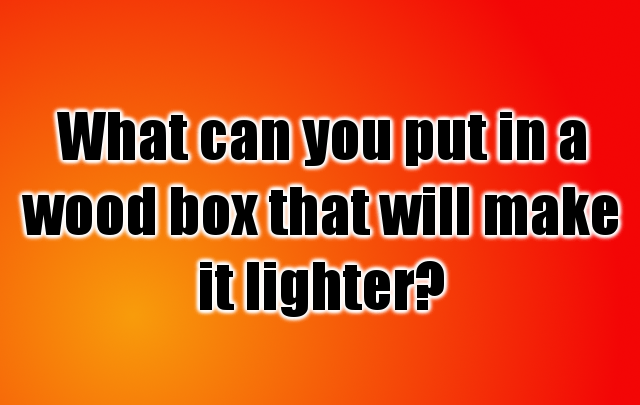
What can you put in a wood box that will make it lighter?
Correct answers: 73
The first user who solved this task is Snezana Milanovic.
#brainteasers #riddles
Register with your Google Account and start collecting points.
Check your ranking on list.

Doctor Doctor Collection 04

Doctor Doctor I feel like a racehorse.
Take one of these every 4 laps!

Doctor, doctor my sister here keeps thinking she's invisible!
What sister?

Doctor, Doctor I'm on a diet and it's making me irritable. Yesterday I bit someones ear off.
Oh dear, that's a lot of calories!

Doctor, Doctor Can I have second opinion?
Of course, come back tomorrow!
Doctor, Doctor you have to help me out!
Certainly, which way did you come in?

Doctor, Doctor I keep thinking I'm God
When did this start?
Well first I created the sun, then the earth...

Doctor, Doctor I keep thinking I'm invisible
Who said that?

Jokes of the day - Daily updated jokes. New jokes every day.
Follow Brain Teasers on social networks

Brain Teasers

puzzles, riddles, mathematical problems, mastermind, cinemania...

Richard Dagobert Brauer

Died 17 Apr 1977 at age 76 (born 10 Feb 1901).German-American mathematician and educator, a pioneer in the development of algebra theory. He worked with Weyl on several projects including a famous joint paper on spinors (published in 1935 in the American Journal of Mathematics). This work provided a background for Paul Dirac's theory of the spinning electron within the framework of quantum mechanics. With Nesbitt, Brauer introduced the theory of blocks (1937). Brauer used this to obtain results on finite groups, particularly finite simple groups, and the theory of blocks would play a big part in much of Brauer's later work. Starting with his group-theoretical characterisation of the simple groups (1951), he spent the rest of his life formulating a method to classify all finite simple groups.
This site uses cookies to store information on your computer. Some are essential to help the site properly. Others give us insight into how the site is used and help us to optimize the user experience. See our privacy policy.