
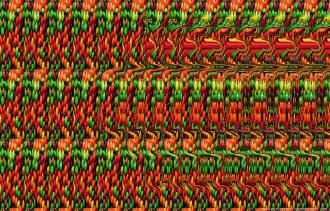
What hides this stereogram?
[1785] What hides this stereogram? - Stereogram - 3D Image - #brainteasers #stereogram #3Dimage
BRAIN TEASERS

What hides this stereogram?

Stereogram - 3D Image
#brainteasers #stereogram #3Dimage
Register with your Google Account and start collecting points.
Check your ranking on list.

This guy was so lonely that he...

This guy was so lonely that he decided life would be more fun if he had a pet. So he went to the pet store and told the owner that he wanted to buy an unusual pet.
After some discussion he finally bought a centipede (100-leg bug), which came in a little white box to use for his house.
He took the box home, found a good location for the box, and decided he would start off by taking his new pet to the bar for a drink. So, he asked the centipede in the box, "Would you like to go to Frank's place with me and have a beer?"
But there was no answer from his new pet. This bothered him a bit, but he waited a few minutes and then asked him again,"How about going to the bar and having a drink with me?"
But again there was no answer from his new friend and pet.So he waited a few minutes more, thinking about the situation. He decided to ask him one more time, this time putting his face up against the centipede's house and shouting, "Hey, in there! Would you like to go to Frank's place and have a drink with me?"
A little voice came out of the box:
"I heard you the first time! I'm putting my shoes on!"
Jokes of the day - Daily updated jokes. New jokes every day.
Follow Brain Teasers on social networks

Brain Teasers

puzzles, riddles, mathematical problems, mastermind, cinemania...

Rock wool

In 1897, a rock wool factory in the U.S., the Crystal Chemical Works, was opened in Alexandria, Ind. Mineral wool had previously been made from blast furnace slag, but the new factory used local limestone rock in a process discovered by Charles Corydon Hall to create a sulphur-free product. The limestone was melted in a specially designed water-jacketed cupola, blown by steam pressure then allowed to cool to form fine threads. Its light, fibrous form resembled freshly-sheared sheep's wool. Being both insectproof and fireproof, rock wool was useful as a filtering material and as an insulating material for such uses as packing walls or for covering steam boilers. In 1929, the works became part of Johns Manville Corp.«
This site uses cookies to store information on your computer. Some are essential to help the site properly. Others give us insight into how the site is used and help us to optimize the user experience. See our privacy policy.