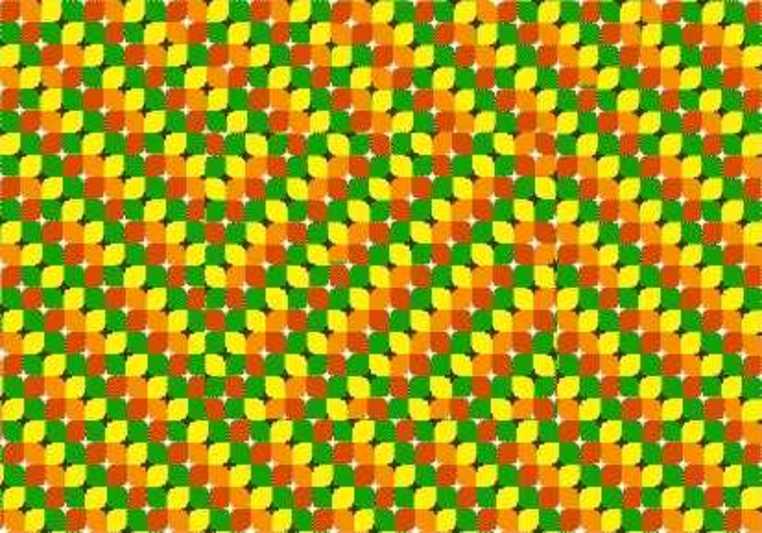
What hides this stereogram?
[2417] What hides this stereogram? - Stereogram - 3D Image - #brainteasers #stereogram #3Dimage
BRAIN TEASERS

What hides this stereogram?

Stereogram - 3D Image
#brainteasers #stereogram #3Dimage
Register with your Google Account and start collecting points.
Check your ranking on list.

Six guys were playing poker wh...

Six guys were playing poker when Smith loses $500 on a single hand, clutches his chest and drops dead at the table. Showing respect for their fallen comrade, the other five complete their playing time standing up. Roberts looks around and asks, "Now, who is going to tell the wife?" They draw straws. Rippington, who is always a loser, picks the short one. They tell him to be discreet, be gentle, don't make a bad situation any worse than it is. "Gentlemen! Discreet? I'm the most discreet man you will ever meet. Discretion is my middle name, leave it to me." Rippington walks over to the Smith house, knocks on the door, the wife answers, and asks what he wants. Rippington says, "Your husband just lost $500 playing cards." She hollers, "TELL HIM TO DROP DEAD!" Rippington says, "I'll tell him.
Jokes of the day - Daily updated jokes. New jokes every day.
Follow Brain Teasers on social networks

Brain Teasers

puzzles, riddles, mathematical problems, mastermind, cinemania...

Daguerrotype

In 1839, the daguerreotype photo process was announced at the French Academy of Science. Previous photographic processes required hours of exposure, but the daguerrotype (named after its inventor Louis Daguerre) needed only a few seconds. The plate was prepared with a layer of photo-sensitive silver halide, was exposed, developed using mercury vapour, and fixed in a solution of sodium hyposulphite. The image remains delicate, and must be protected under glass against damage by touching. The daguerreotype was produced with a direct positive image, needing no intermediate negative, but thus could not yield multiple reproductions made possible by later photographic processes.«[Image: first daguerrotype portrait in the Library of Congress collection. It shows a self-portrait of Robert Cornelius (1809-1893).]
This site uses cookies to store information on your computer. Some are essential to help the site properly. Others give us insight into how the site is used and help us to optimize the user experience. See our privacy policy.