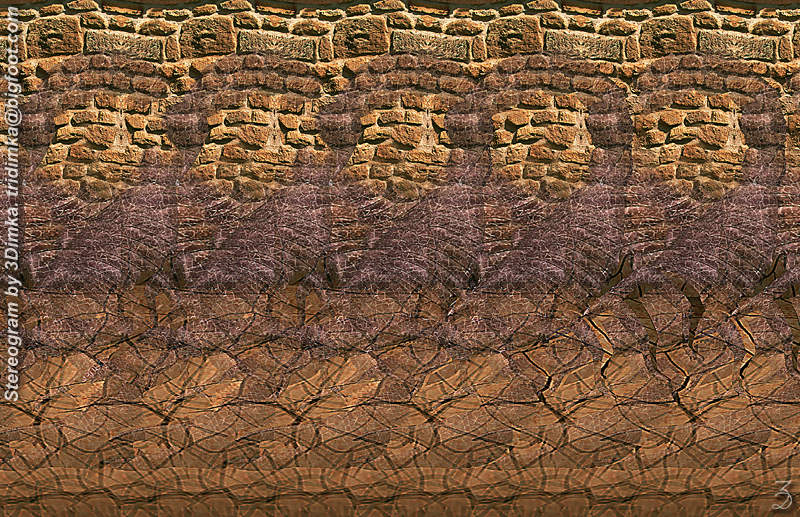
What hides this stereogram?
[2582] What hides this stereogram? - Stereogram - 3D Image - #brainteasers #stereogram #3Dimage
BRAIN TEASERS

What hides this stereogram?

Stereogram - 3D Image
#brainteasers #stereogram #3Dimage
Register with your Google Account and start collecting points.
Check your ranking on list.

Error Messages in Japan

In Japan, they have replaced the impersonal and unhelpful Microsoft Error messages with Haiku poetry messages.
Haiku poetry has strict construction rules.
Each poem has only 3 lines, 17 syllables: five syllables in the first line, seven in the second, five in the third.
Haikus are used to communicate a timeless message, often achieving a wistful, yearning, and powerful insight  through extreme brevity -- the essence of Zen.

Your file was too big.
It might be very useful.
But now it is gone.
-------------------------------
The Web site you seek
Cannot be located, but
Countless more exist.
------------------------------
Chaos reigns within.
Reflect, repent, and reboot.
Order shall return.
-----------------------------
Program aborting:
Close all that you have worked on.
You ask far too much.
------------------------------
Windows 10 crashed.
I am the Blue Screen of Death.
No one hears your screams.
------------------------------
Yesterday it worked.
Today it is not working.
Windows is like that.

Jokes of the day - Daily updated jokes. New jokes every day.
Follow Brain Teasers on social networks

Brain Teasers

puzzles, riddles, mathematical problems, mastermind, cinemania...

Bronislaw Malinowski

Died 16 May 1942 at age 58 (born 7 Apr 1884). Bronislaw Kasper Malinowski was a Polish-British anthropologist, one of the most important in the 20th century, who is widely recognized as the founder of social anthropology. He is principally associated with field studies of the peoples of Oceania. In 1914, on a research assignment to Australia, the outbreak of WW I kept him partially confined to the Trobriand Islands, off the eastern tip of New Guinea. In 1920, he returned to teaching in London, and in 1938 moved to teach in the U.S. He was the pioneer of “participant observation”as a method of fieldwork, used in his works on the Trobriand Islanders, especially Argonauts of the Western Pacific (1922) and Coral Gardens and their Magic (2 vols, 1935), which set new standards for ethnographic description.
This site uses cookies to store information on your computer. Some are essential to help the site properly. Others give us insight into how the site is used and help us to optimize the user experience. See our privacy policy.