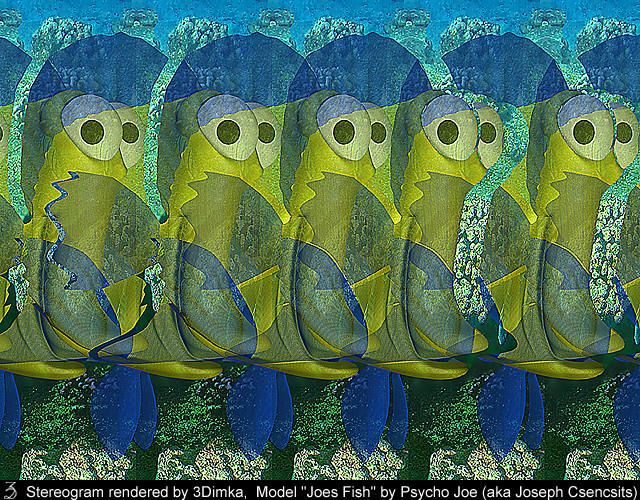
What hides this stereogram?
[3826] What hides this stereogram? - Stereogram - 3D Image - #brainteasers #stereogram #3Dimage
BRAIN TEASERS

What hides this stereogram?

Stereogram - 3D Image
#brainteasers #stereogram #3Dimage
Register with your Google Account and start collecting points.
Check your ranking on list.

World Art Day Joke

Today is World Art Day! Find a joke about it!

What do you call someone hanging out by the wall?
Art.

Why couldn’t the man afford expensive art?
He had no Monet.

Why was the artist hauled to court?
To face the mosaic.

What is Salvador Dali’s favorite thing to eat for breakfast?
A bowl of surreal.

Which famous painting is always sad?
The Moaning Lisa.

Why did Van Gogh become a painter?
Because he didn’t have an ear for music.

What sound does a dog that’s really into art make?
He doesn’t bark. He bauhaus.

Why did the artist decide not to quit running?
He was on the home sketch.

What is it called when someone mislabels a color?
A false ac-hue-sation.

Why did the investor buy art?
For art appreciation.

#worldartday

Jokes of the day - Daily updated jokes. New jokes every day.
Follow Brain Teasers on social networks

Brain Teasers

puzzles, riddles, mathematical problems, mastermind, cinemania...

Niccolò Fontana Tartaglia

Died 13 Dec 1557 (born 1499).Italian mathematician who originated the science of ballistics. His proper name was Niccolo Fontana although he is always known by his nickname, Tartaglia, which means the "stammerer." When the French sacked Brescia in 1512, soldiers killed his father and left young Tartaglia for dead with a sabre wound that cut his jaw and palate. In 1535, by winning a competition to solve cubic equations, he gained fame as the discoverer of the formula for their algebraic solution (which was published in Cardan's Ars Magna, 1545) Tartaglia wrote Nova Scientia (1537) on the application of mathematics to artillery fire. He described new ballistic methods and instruments, including the first firing tables. He was the first Italian translator and publisher of Euclid's Elements (1543).
This site uses cookies to store information on your computer. Some are essential to help the site properly. Others give us insight into how the site is used and help us to optimize the user experience. See our privacy policy.