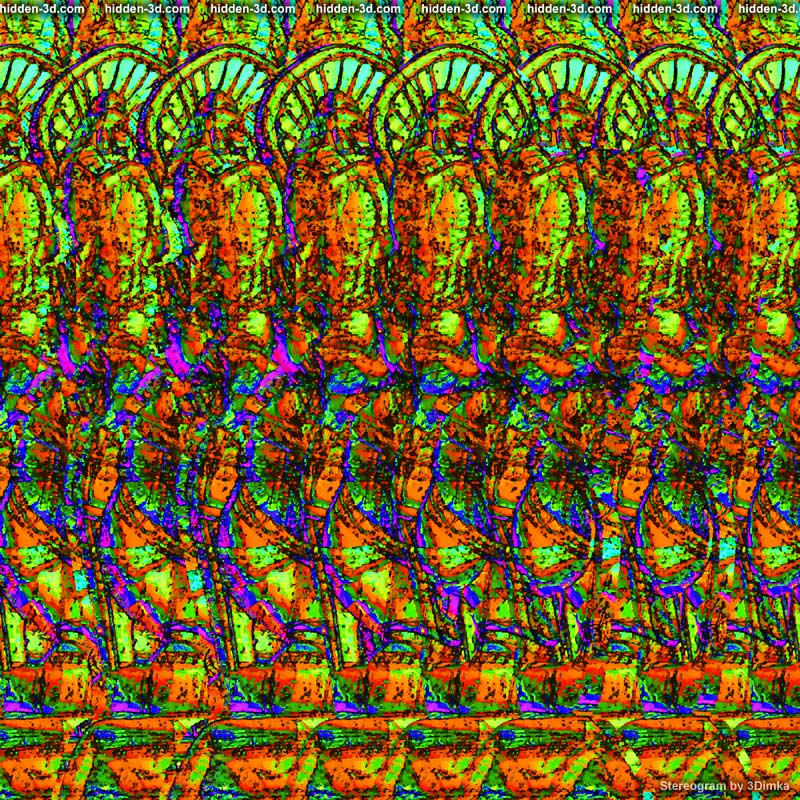
What hides this stereogram?
[3962] What hides this stereogram? - Stereogram - 3D Image - #brainteasers #stereogram #3Dimage
BRAIN TEASERS

What hides this stereogram?

Stereogram - 3D Image
#brainteasers #stereogram #3Dimage
Register with your Google Account and start collecting points.
Check your ranking on list.

Vacuum Cleaner Salesman

A little old lady answered a knock on the door one day, only to be confronted by a well-dressed young man carrying a vacuum cleaner. Good morning," said the young man. "If I could take a couple of minutes of your time, I would like to demonstrate the very latest in high-powered vacuum cleaners.
"Go away!" said the old lady. "I haven't got any money!" and she proceeded to close the door..
Quick as a flash, the young man wedged his foot in the door and pushed it wide open. "Don't be too hasty!" he said. "Not until you have at least seen my demonstration." And with that, he emptied a bucket of horse manure onto her hallway carpet. "If this vacuum cleaner does not remove all traces of this horse manure from your carpet, Madam, I will personally eat the remainder."
The old lady stepped back and said, "Well I hope you've got a damned good appetite, because they cut off my electricity this morning.."    

Jokes of the day - Daily updated jokes. New jokes every day.
Follow Brain Teasers on social networks

Brain Teasers

puzzles, riddles, mathematical problems, mastermind, cinemania...

Francis William Aston

Born 1 Sep 1877; died 20 Nov 1945 at age 68. English chemist, physicist and chemist who was awarded the 1922 Nobel Prize for Chemistry for his development of the mass spectrograph, a device that separates atoms or molecular fragments of different mass and measures those masses with remarkable accuracy. In 1910 he became an assistant to Sir J.J. Thomson at Cambridge, who was investigating positively charged rays emanating from gaseous discharges. Aston invented his mass spectrograph (a new type of positive-ray apparatus) after WWI, with which he showed that many elements are mixtures of isotopes. In fact, he discovered 212 of the 287 naturally occurring nuclides. The mass spectrograph is now widely used in geology, chemistry, biology, and nuclear physics.
This site uses cookies to store information on your computer. Some are essential to help the site properly. Others give us insight into how the site is used and help us to optimize the user experience. See our privacy policy.