
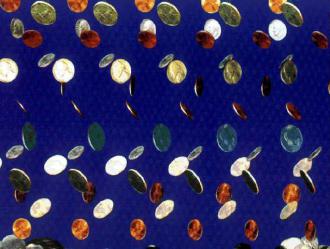
What hides this stereogram?
[4138] What hides this stereogram? - Stereogram - 3D Image - #brainteasers #stereogram #3Dimage
BRAIN TEASERS

What hides this stereogram?

Stereogram - 3D Image
#brainteasers #stereogram #3Dimage
Register with your Google Account and start collecting points.
Check your ranking on list.

Passing a Mental Exam

Three patients in a mental institution prepare for an examination given by the head psychiatrist. If the patients pass the exam, they will be free to leave the hospital. However, if they fail, the institution will detain them for five years.
The doctor takes the three patients to the top of a diving board looking over an empty swimming pool, and asks the first patient to jump.
The first patient jumps head first into the pool and breaks both arms.
Then the second patient jumps and breaks both legs.
The third patient looks over the side and refuses to jump. "Congratulations! You're a free man. Just tell me why didn't you jump?" asked the doctor.

To which the third patient answered, "Well Doc, I can't swim!"

Jokes of the day - Daily updated jokes. New jokes every day.
Follow Brain Teasers on social networks

Brain Teasers

puzzles, riddles, mathematical problems, mastermind, cinemania...

Hermann Minkowski

Born 22 Jun 1864; died 12 Jan 1909 at age 44. German mathematician who developed the geometrical theory of numbers and who used geometrical methods to solve difficult problems in number theory, mathematical physics, and the theory of relativity. By 1907, Minkowski realised that the work of Lorentz and Einstein could be best understood in a non-euclidean space. He considered space and time, which were formerly thought to be independent, to be coupled together in a four-dimensional "space-time continuum". Minkowski worked out a four-dimensional treatment of electrodynamics. His idea of a four-dimensional space (since known as "Minkowski space"), combining the three dimensions of physical space with that of time, laid the mathematical foundation of Albert Einstein's general theory of relativity.
This site uses cookies to store information on your computer. Some are essential to help the site properly. Others give us insight into how the site is used and help us to optimize the user experience. See our privacy policy.