
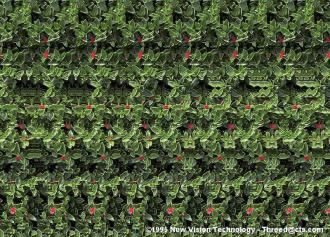
What hides this stereogram?
[4339] What hides this stereogram? - Stereogram - 3D Image - #brainteasers #stereogram #3Dimage
BRAIN TEASERS

What hides this stereogram?

Stereogram - 3D Image
#brainteasers #stereogram #3Dimage
Register with your Google Account and start collecting points.
Check your ranking on list.

Nice cheeks

A married couple was in a terrible accident where the woman's face was severely burned. The doctor told the husband that they couldn't graft any skin from her body because she was too skinny. So the husband offered to donate some of his own skin.

However, the only skin on his body that the doctor felt was suitable would have to come from his buttocks. The husband and wife agreed that they would tell no one about where the skin came from, and requested that the doctor also honor their secret. After all, this was a very delicate matter.

After the surgery was completed, everyone was astounded at the woman's new beauty. She looked more beautiful than she ever had before! All her friends and relatives just went on and on about her youthful beauty!

One day, she was alone with her husband, and she was overcome with emotion at his sacrifice. She said, 'Dear, I just want to thank you for everything you did for me. There is no way I could ever repay you.'

'My darling,' he replied, 'I get all the thanks I need every time I see your mother kiss you on the cheek.

Jokes of the day - Daily updated jokes. New jokes every day.
Follow Brain Teasers on social networks

Brain Teasers

puzzles, riddles, mathematical problems, mastermind, cinemania...

Herbert Copeland

Died 15 Oct 1968 at age 66 (born 21 May 1902).Herbert Faulkner Copeland was an American biologist who delineated four biological kingdoms, instead of just two for plants and animals. A decade after Darwin's Origin of Species, Ernst Haekel had proposed (1866) adding a kingdom, Protista, for microorganisms, but it wasn't accepted. Copeland further discriminated among the microorganisms in a paper in 1938, splitting them into two kingdoms: Monera and Protista. Copeland identified Monera as organisms without nuclei, and Protista as being largely unicellular, with nuclei. By 1956, he published a book,The Classification of Lower Organisms, still trying “to pursuade the community of biologists” to adopt these four kingdoms. Change came slowly, and continues beyond Copeland's ideas to now five or six. He was the son of botanist Edwin B. Copeland, from whom he learned the principles of classification.«
This site uses cookies to store information on your computer. Some are essential to help the site properly. Others give us insight into how the site is used and help us to optimize the user experience. See our privacy policy.