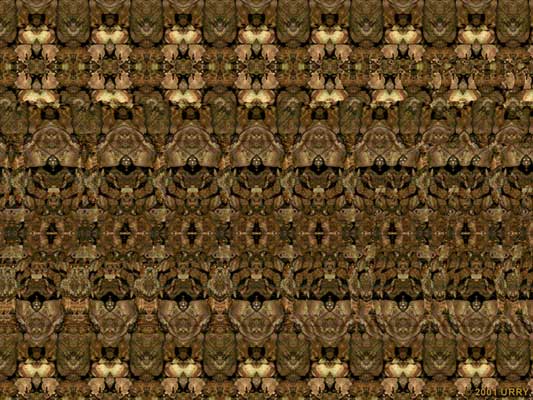
What is hidden in 3D image?
[3774] What is hidden in 3D image? - Stereogram - 3D Image - #brainteasers #stereogram #3Dimage
BRAIN TEASERS

What is hidden in 3D image?

Stereogram - 3D Image
#brainteasers #stereogram #3Dimage
Register with your Google Account and start collecting points.
Check your ranking on list.

Anagrams

George Bush: When you rearrange the letters: He Bugs Gore

Dormitory: When you rearrange the letters: Dirty Room

Evangelist: When you rearrange the letters: Evil's Agent

Desperation: When you rearrange the letters: A Rope Ends It

The Morse Code: When you rearrange the letters: Here Come Dots

Slot Machines: When you rearrange the letters: Cash Lost in Em

Animosity: When you rearrange the letters: Is No Amity

Snooze Alarms: Wen you rearrange the letters: Alas No More Z's

A Decimal Point: When you rearrange the letters: I'm a Dot in Place

Eleven plus two: When you rearrange the letters: Twelve plus one

Jokes of the day - Daily updated jokes. New jokes every day.
Follow Brain Teasers on social networks

Brain Teasers

puzzles, riddles, mathematical problems, mastermind, cinemania...

Andromeda outside Milky way

In 1924, a meeting of scientists began in Washington, D.C. On its last day, 1 Jan 1925, its main event was a paper read by H. N. Russell on behalf of the absent author, Edwin Hubble. Although titled about Cepheid Variables, Hubble's paper gave the first proof that Andromeda was a separate galactic system—an “island universe,” far beyond our own Milky Way, and equally large. Previously, scientists couldn't tell if nebulae (fuzzy clouds of light) were within the Milky Way or not. Hubble measured the distances to Cepheid stars in the Andromeda nebula and showed it was a hundred thousand times as far away as the nearest stars—proof it was a separate galaxy. He wrote a letter to Harlow Shapley on 19 Feb 1923 about his first measurement. New York Times (22 Nov 1924) told the public, before the meeting.«
This site uses cookies to store information on your computer. Some are essential to help the site properly. Others give us insight into how the site is used and help us to optimize the user experience. See our privacy policy.