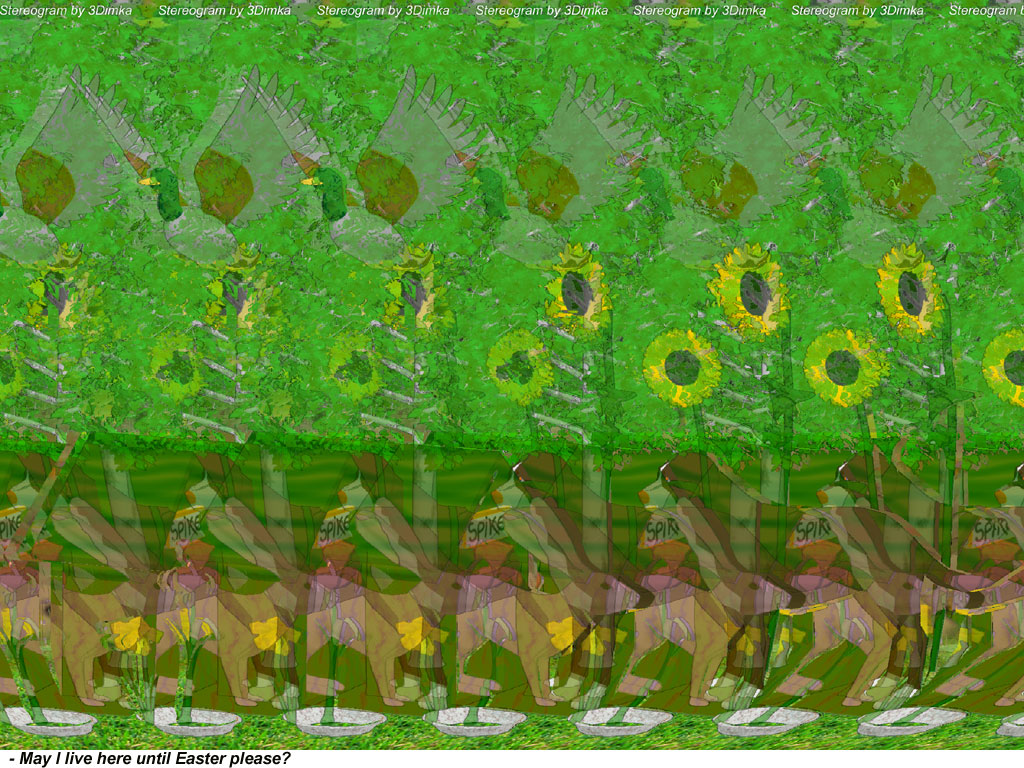

What is hidden in 3D image?
[4397] What is hidden in 3D image? - Stereogram - 3D Image - #brainteasers #stereogram #3Dimage
BRAIN TEASERS

What is hidden in 3D image?

Stereogram - 3D Image
#brainteasers #stereogram #3Dimage
Register with your Google Account and start collecting points.
Check your ranking on list.

Train Test

Tom is applying for a job as a signalman for the local railroad and is told to meet the inspector at the signal box.
The inspector decides to give Tom a pop quiz, asking: "What would you do if you realized that two trains were heading towards each other on the same track?"
Tom says: "I would switch one train to another track."
"What if the lever broke?" asks the inspector.
"Then I'd run down to the tracks and use the manual lever down there", answers Tom.
"What if that had been struck by lightning?" challenges the inspector.
"Then," Tom continued, "I'd run back up here and use the phone to call the next signal box."
"What if the phone was busy?"
"In that case," Tom argued, "I'd run to the street level and use the public phone near the station".
"What if that had been vandalized?"
"Oh well," said Tom, "in that case I would run into town and get my Uncle Leo".
This puzzled the inspector, so he asked, "Why would you do that?"
"Because he's never seen a train crash."

Jokes of the day - Daily updated jokes. New jokes every day.
Follow Brain Teasers on social networks

Brain Teasers

puzzles, riddles, mathematical problems, mastermind, cinemania...

Charles Martin Hall

Died 27 Dec 1914 at age 51 (born 6 Dec 1863).American chemist who invented the inexpensive electrolytic method of extracting aluminium from its ore, enabling the wide commercial use of this metal. While a young chemist, he experimented in a woodshed, intent upon finding a method for separating aluminum from its ore. At first, he was unsuccessful, but then realized that he needed a nonaqueous solvent for the aluminum oxide during electrolysis. On 23 Feb 1886, Hall found that molten cryolite (the mineral sodium aluminum fluoride) was a suitable solvent and using carbon electrodes with home-made batteries, he produced his first small globules of aluminum. By 1914, Hall's process had brought the cost of aluminium, once a precious metal used for fine jewelry, down to 18 cents a pound.«
This site uses cookies to store information on your computer. Some are essential to help the site properly. Others give us insight into how the site is used and help us to optimize the user experience. See our privacy policy.