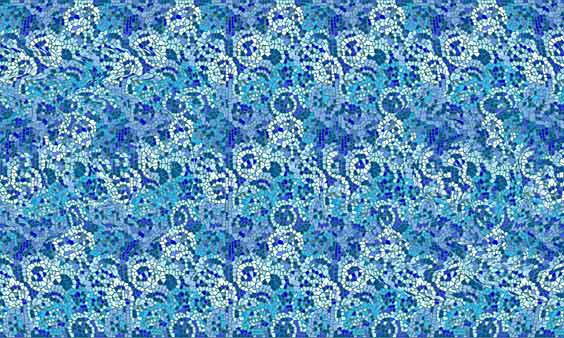
What is hidden in 3D image?
[4702] What is hidden in 3D image? - Stereogram - 3D Image - #brainteasers #stereogram #3Dimage
BRAIN TEASERS

What is hidden in 3D image?

Stereogram - 3D Image
#brainteasers #stereogram #3Dimage
Register with your Google Account and start collecting points.
Check your ranking on list.

Two buddies are fishing, but

Two buddies are fishing, but they haven’t caught anything all day. Then, another fisherman walks by with a huge load of fish. They ask him "excuse me, but where did you get all those fish?"
The other fisherman replies,” If you just go down the stream until the water isn't salty, there are a ton of hungry fish."
They thank him and go on their way. 15 minutes later, one fisherman says to the other "fill the bucket up with water and see if the water is salty."
He dips the bucket in the stream and drinks some. "Nope. Still salty." 30 minutes later, he asks him to check again.
"Nope, still salty." One our later they check again. "Nope. Still salty."
"This isn't good," the fisherman finally says. "We have been walking for almost two hours and the water is still salty!"
"I know," says the other. "And the bucket is almost empty!"
Jokes of the day - Daily updated jokes. New jokes every day.
Follow Brain Teasers on social networks

Brain Teasers

puzzles, riddles, mathematical problems, mastermind, cinemania...

Rudolf Virchow

Died 5 Sep 1902 at age 80 (born 13 Oct 1821). German pathologist and statesman who originated the concept that disease arises in the individual cells of a tissue and, with publication of his Cellular Pathology (1858), founded the science of cellular pathology. Virchow also worked on improving sanitary conditions in Berlin, and believed that environmental factors such as poor living conditions could be as much a cause of disease as germs. He also helped develop the science of anthropology in Germany and to make Berlin a European centre of medicine. Virchow encouraged his friend Heinrich Schliemann in his determination to discover the site of Homer's Troy and actually worked on the dig at Hissarlik in 1879.
This site uses cookies to store information on your computer. Some are essential to help the site properly. Others give us insight into how the site is used and help us to optimize the user experience. See our privacy policy.