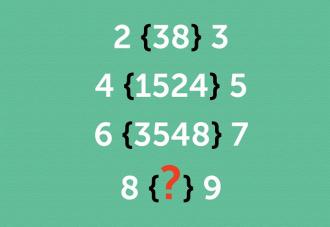
What is the missing number?
[5000] What is the missing number? - MATH PUZZLE: Can you replace the question mark with a number? - #brainteasers #math #riddles - Correct Answers: 72 - The first user who solved this task is Djordje Timotijevic
BRAIN TEASERS
enter your answer and press button OK

What is the missing number?

MATH PUZZLE: Can you replace the question mark with a number?
Correct answers: 72
The first user who solved this task is Djordje Timotijevic.
#brainteasers #math #riddles
Register with your Google Account and start collecting points.
Check your ranking on list.

TIME

A man had been driving all night and by morning was still far from his destination. He decided to stop at the next city he came to, and park somewhere quiet so he could get an hour or two of sleep. As luck would have it, the quiet place he chose happened to be on one of the city's major jogging routes. No sooner had he settled back to snooze when there came a knocking on his window. He looked out and saw a jogger running in place.

“Yes?”

“Excuse me, sir,” the jogger said, “do you have the time?”

The man looked at the car clock and answered, “8:15″. The jogger said thanks and left. The man settled back again, and was just dozing off when there was another knock on the window and another jogger.

“Excuse me, sir, do you have the time?”

“8:25!”

The jogger said thanks and left. Now the man could see other joggers passing by and he knew it was only a matter of time before another one disturbed him. To avoid the problem, he got out a pen and paper and put a sign in his window saying, “I do not know the time!”

Once again he settled back to sleep. He was just dozing off when there was another knock on the window.

“Sir, sir? It's 8:45!”

Jokes of the day - Daily updated jokes. New jokes every day.
Follow Brain Teasers on social networks

Brain Teasers

puzzles, riddles, mathematical problems, mastermind, cinemania...

Ernest Henry Starling

Died 2 May 1927 at age 61 (born 17 Apr 1866). English physiologist whose prolific contributions to a modern understanding of body functions include Starling's hypothesis (in which he described the forces that propel fluids through blood vessels) and his discovery of how hormones and nerves control digestion. He coined the term "hormone" for the body's chemical messengers from the endocrine glands (1905). His "law of the heart" stated the strength of the heart contraction is proportional to the stretching of the heart muscle. He discovered the functional significance of serum proteins. In 1902 along with William Bayliss he demonstrated that secretin stimulates pancreatic secretion. In 1924 along with E. B. Vernay he demonstrated the reabsorption of water by the tubules of the kidney.
This site uses cookies to store information on your computer. Some are essential to help the site properly. Others give us insight into how the site is used and help us to optimize the user experience. See our privacy policy.