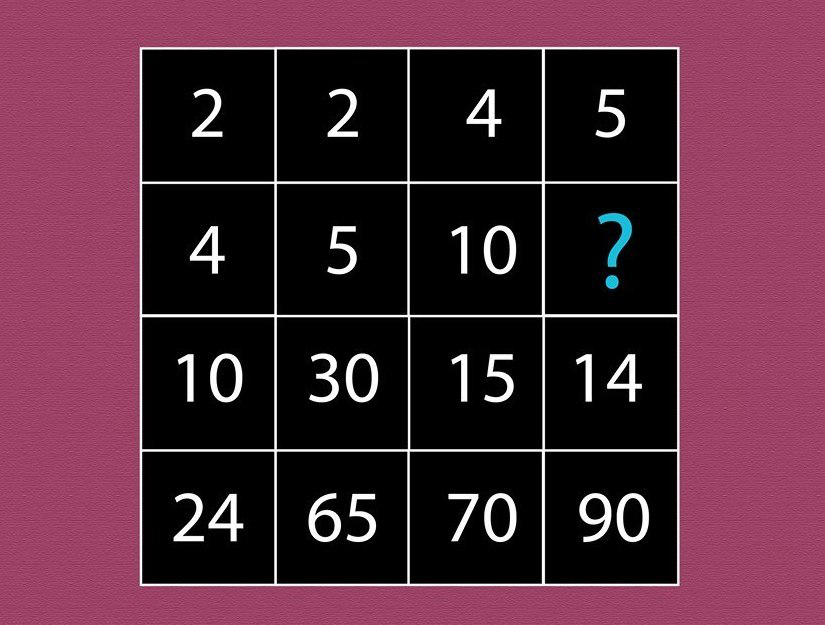
What is the missing number?
[5046] What is the missing number? - MATH PUZZLE: Can you replace the question mark with a number? - #brainteasers #math #riddles - Correct Answers: 68 - The first user who solved this task is Jakubovski Vladimir
BRAIN TEASERS
enter your answer and press button OK

What is the missing number?

MATH PUZZLE: Can you replace the question mark with a number?
Correct answers: 68
The first user who solved this task is Jakubovski Vladimir.
#brainteasers #math #riddles

Register with your Google Account and start collecting points.
Check your ranking on list.

A pious man who had reached th...

A pious man who had reached the age of 105 suddenly stopped going to synagogue. Alarmed by the old fellow's absence after so many years of faithful attendance the Rabbi went to see him.
He found him in excellent health, so the Rabbi asked, "How come after all these years we don't see you at services anymore?"
The old man looked around and lowered his voice. "I'll tell you, Rabbi," he whispered. "When I got to be 90, I expected God to take me any day. But then I got to be 95, then 100, then 105. So I figured that God is very busy and must've forgotten about me, and I don't want to remind Him!"
Jokes of the day - Daily updated jokes. New jokes every day.
Follow Brain Teasers on social networks

Brain Teasers

puzzles, riddles, mathematical problems, mastermind, cinemania...

Jean Henri Fabre

Died 11 Oct 1915 at age 91 (born 22 Dec 1823). French entomologist and author who popularized insect natural history. He wrote ten volumes of Souvenirs entomologiques (1879-1907) in which he recorded his perceptive field observations of insect behaviour. Although his career began as a professor of physics, and in 1866 he isolated alizarin (the colouring agent in madder), his life work became the study of insects, about which he wrote in elegant prose. From his study of parasitic wasps he deduced that much of the wasp's behaviour is inherited and not learned. Victor Hugo dubbed him “the insects' Homer”and Edmond Rostand named him the “Virgil of insects.” Darwin cited him as “an incomparable observer.”«
This site uses cookies to store information on your computer. Some are essential to help the site properly. Others give us insight into how the site is used and help us to optimize the user experience. See our privacy policy.