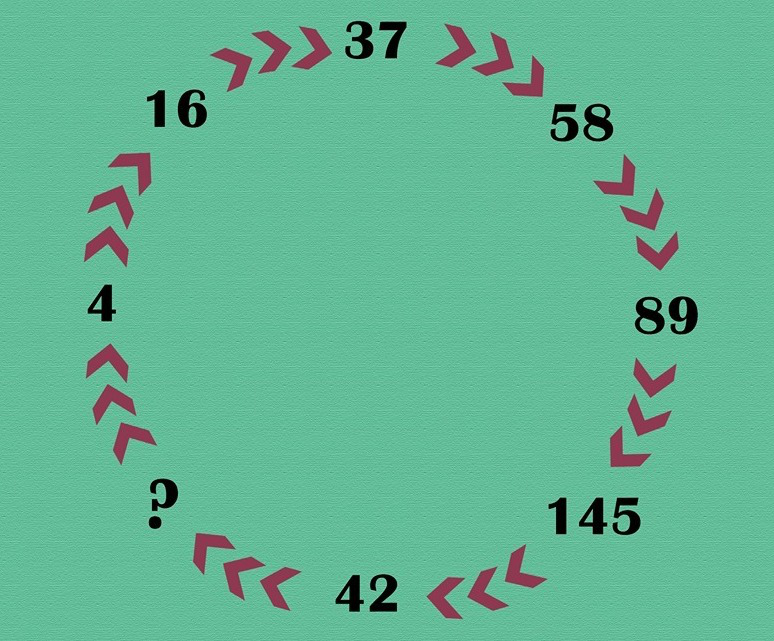
What is the missing number?
[5108] What is the missing number? - MATH PUZZLE: Can you replace the question mark with a number? - #brainteasers #math #riddles - Correct Answers: 45 - The first user who solved this task is Thinh Ddh
BRAIN TEASERS
enter your answer and press button OK

What is the missing number?

MATH PUZZLE: Can you replace the question mark with a number?
Correct answers: 45
The first user who solved this task is Thinh Ddh.
#brainteasers #math #riddles
Register with your Google Account and start collecting points.
Check your ranking on list.

A man exploring the ancient Py...

A man exploring the ancient Pyramids of Egypt while on vacation stumbled across a secret room. He sneaked away from the tour group and explored the room. He found a dusty lamp and picked it up. While he wiped the dust off the lamp a genie appeared in a puff of smoke.
"For freeing me from my prison, I will grant you a wish, what will it be sire?"
The man thought for a moment, then said, "I want a spectacular job, a job that no man has ever succeeded at or has ever attempted to do."
"Allah Ka Zam!" said the genie. "You're a housewife!"
Jokes of the day - Daily updated jokes. New jokes every day.
Follow Brain Teasers on social networks

Brain Teasers

puzzles, riddles, mathematical problems, mastermind, cinemania...

Sir Edwin Ray Lankester

Born 15 May 1847; died 15 Aug 1929 at age 82. British zoologist whose interests embraced comparative anatomy, protozoology, parasitology, embryology and anthropology. He was one of the first to describe protozoan parasites found in the blood of vertebrates. Lankestrella (a parasite related to the causative agent of malaria) carries his name. His work contributed to an understanding of the disease. Based on his investigation into the comparative anatomy of the embryology of invertebrates, Lankester endorsed Darwin's theory of evolution, In anthrolopology, his activities included the discovery of flint implements, evidence of early man, in Pliocene sediments, Suffolk. He was Director of the British Museum of Natural History (1898-1907).«
This site uses cookies to store information on your computer. Some are essential to help the site properly. Others give us insight into how the site is used and help us to optimize the user experience. See our privacy policy.