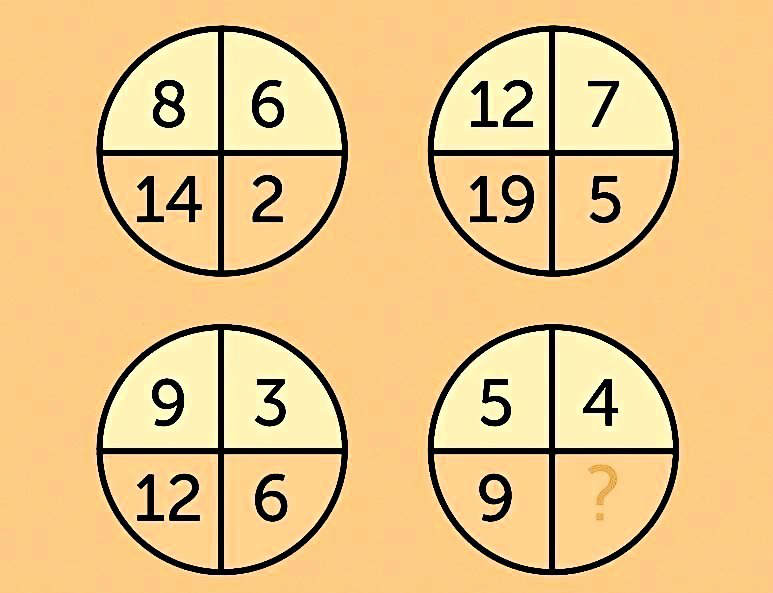
What is the missing number?
[5832] What is the missing number? - What is the missing number? - #brainteasers #math #riddles - Correct Answers: 160 - The first user who solved this task is Fazil Hashim
BRAIN TEASERS
enter your answer and press button OK

What is the missing number?

What is the missing number?
Correct answers: 160
The first user who solved this task is Fazil Hashim.
#brainteasers #math #riddles
Register with your Google Account and start collecting points.
Check your ranking on list.

Immaculate Misconception

A woman starts dating a doctor. Before too long, she becomes pregnant and they don't know what to do. About nine months later, just about the time she is going to give birth, a priest goes into the hospital for a prostate gland infection.

The doctor says to the woman: "I know what we'll do. After I've operated on the priest, I'll give the baby to him and tell him it was a miracle."

"Do you think it will work?" she asks.

"It's worth a try," he says.

So, the doctor delivers the baby and then operates on the priest. After the operation he goes in to the priest and says: "Father, you're not going to believe this."

"What happened?" asks the priest.

"You gave birth to a child!"

"But that's impossible!" says the priest.

"I just did the operation," insists the doctor. "It's a miracle! Here's your baby."

About 15 years go by, and the priest realizes he must tell his son the truth. One day, he sits the boy down and says: "Son, I have something to tell you. I'm not your father."

The son says: "What do you mean, you're not my father?"

The priest replies: "I am your mother. The archbishop is your father."

Jokes of the day - Daily updated jokes. New jokes every day.
Follow Brain Teasers on social networks

Brain Teasers

puzzles, riddles, mathematical problems, mastermind, cinemania...

Sir Leonard Woolley

Born 17 Apr 1880; died 20 Feb 1960 at age 79.Charles Leonard Woolley was an English archaeologist whose excavation (1922-34) of the ancient Sumerian city of Ur (in modern Iraq), the royal burial site of many Mesopotamian royalties, greatly advanced knowledge of ancient Mesopotamian civilization, enabling scholars to trace the history of the city from its final days during the 4th century BC back to its prehistoric beginnings (c. 4000 BC). His finds revealed much about everyday life, art, architecture, literature, government, and religion in this "cradle of civilization. " In royal tombs dating from about 2700 BC, he uncovered the practice of the sacrificial burial of a deceased king's personal retinue. He discovered tombs of great material wealth, gold and silver jewelry, large paintings of ancient Mesopotamian culture at its zenith, and other furnishings. The most extravagant tomb of Queen Pu-Abi was untouched by the hands of looters through the millennia, with many well-preserved items, including a cylindrical seal bearing her name in Sumerian. His widely read Ur of the Chaldees: A record of seven years of excavation (1929), described his findings in a manner both informative to specialists and accessible by lay-persons.
This site uses cookies to store information on your computer. Some are essential to help the site properly. Others give us insight into how the site is used and help us to optimize the user experience. See our privacy policy.