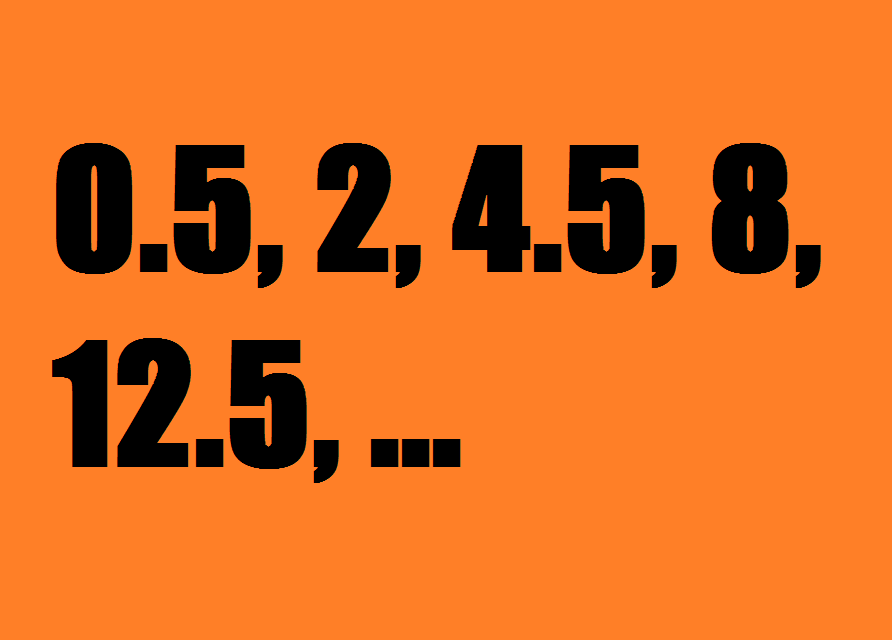
What is the next number in this series?
[4880] What is the next number in this series? - Look at the series (0.5, 2, 4.5, 8, 12.5, ?), determine the pattern, and find the value of the next number! - #brainteasers #math #riddles - Correct Answers: 85 - The first user who solved this task is Manguexa Wagle
BRAIN TEASERS
enter your answer and press button OK

What is the next number in this series?

Look at the series (0.5, 2, 4.5, 8, 12.5, ?), determine the pattern, and find the value of the next number!
Correct answers: 85
The first user who solved this task is Manguexa Wagle.
#brainteasers #math #riddles
Register with your Google Account and start collecting points.
Check your ranking on list.

Finding Jesus

An old drunk stumbles across a baptismal service on Sunday afternoon down by the river.
He proceeds to walk into the water and stand next to the preacher. The minister notices the old drunk and says, "Mister, are you ready to find Jesus?"
The drunk looks back and says, "Yes, preacher, I sure am."
The minister dunks the fellow under the water and pulls him right back up.
"Have you found Jesus?" the preacher asks."Nooo, I didn't!" said the drunk.
The preacher then dunks him under for quite a bit longer, brings him up, and says, "Now, brother, have you found Jesus?"
"Noooo, I have not, Reverend."
The preacher, in disgust, holds the man under for at least 30 seconds this time, brings him out of the water, and says in a harsh tone, "My God, man, have you found Jesus yet?"
The old drunk wipes his eyes and says to the preacher, "Are you sure this is where he fell in?"

Jokes of the day - Daily updated jokes. New jokes every day.
Follow Brain Teasers on social networks

Brain Teasers

puzzles, riddles, mathematical problems, mastermind, cinemania...

Neon lights

In 1910, neon lighting, developed by French physicist Georges Claude, made its public debut at the Paris Motor Show. The coloured light is produced by passing electrical current through inert gases in a vacuum tube. This effect was produced following decades of experiments to create a practical alternative to incandescent lighting. Neon signage came to America when Earle C. Anthony bought two signs for $2400 in Paris and installed them in his Los Angeles Packard dealership. Neon gas glows a fiery orange-red; argon is soft lavender; argon gas enhanced with mercury is brilliant blue. More than 150 colors can be achieved by combining different gasses (including krypton, xenon and helium) and phosphors that coat the inside of the glass tube.
This site uses cookies to store information on your computer. Some are essential to help the site properly. Others give us insight into how the site is used and help us to optimize the user experience. See our privacy policy.