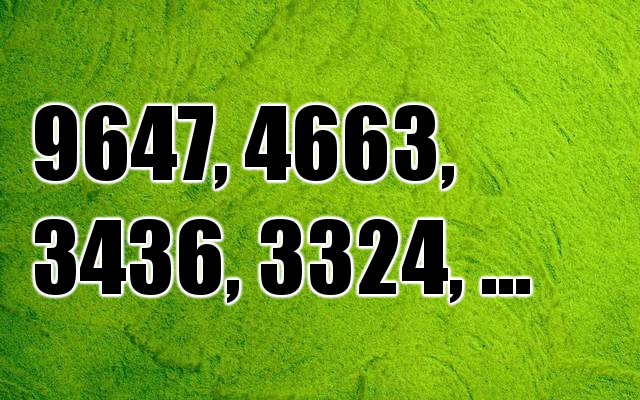
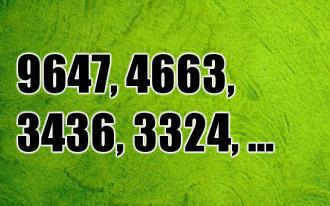
What number comes next?
[3101] What number comes next? - Look at the series (9647, 4663, 3436, 3324, ?), determine the pattern, and find the value of the next number! - #brainteasers #math #riddles - Correct Answers: 52 - The first user who solved this task is Sanja Šabović
BRAIN TEASERS
enter your answer and press button OK

What number comes next?

Look at the series (9647, 4663, 3436, 3324, ?), determine the pattern, and find the value of the next number!
Correct answers: 52
The first user who solved this task is Sanja Šabović.
#brainteasers #math #riddles
Register with your Google Account and start collecting points.
Check your ranking on list.

A husband and wife are moving...

A husband and wife are moving out of their house and are starting to box everything up. The husband finds a box under the bed, pulls it out, and looks inside, where he finds two eggs and about $8,000. He approaches the wife and asks, "What are the eggs for?" She replies, "Every time I cheat on you, I put an egg in the box." He says, "That's alright, you've only cheated on me twice. What's the money for?" The wife replies, "Every time I get a dozen, I sell them!"
Jokes of the day - Daily updated jokes. New jokes every day.
Follow Brain Teasers on social networks

Brain Teasers

puzzles, riddles, mathematical problems, mastermind, cinemania...

Francis R. "Joe" Boyd

Died 12 Jan 2004 at age 77 (born 26 Jan 1926).American geologist whose studies on the origins of volcanic rocks contributed to the understanding of the formation of the Earth. In Yellowstone National Park, he discovered that the volcanic eruptions that formed Yellowstone Plateau produced rocks of an unusual type, called welded tuff. In the 1960s, he helped develop the Boyd-English device, a piston-cylinder laboratory apparatus to simulate the pressure exerted on minerals deep within the Earth. Able to create a synthetic diamond, it also helps scientists determine the nature of minerals in the various rock layers of the Earth. He was a leading authority on the mantle root of the 3.5-billion-year-old Kaapvaal craton (the kernel on which a continent grows) rock in southern Africa.
This site uses cookies to store information on your computer. Some are essential to help the site properly. Others give us insight into how the site is used and help us to optimize the user experience. See our privacy policy.