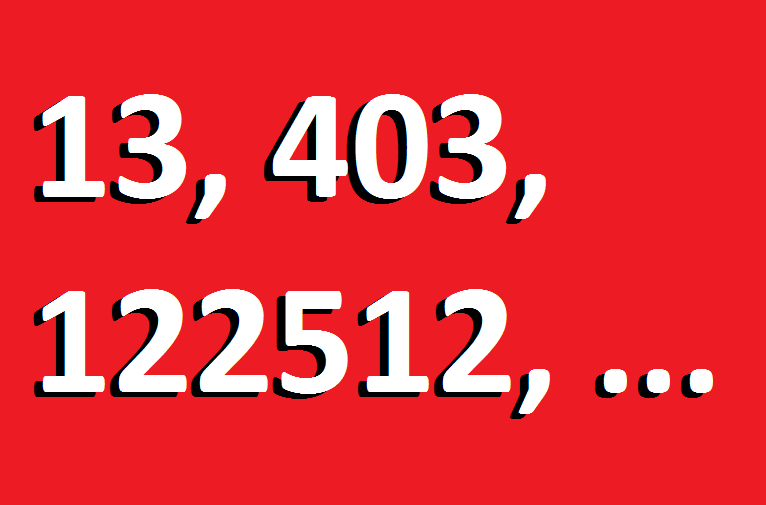
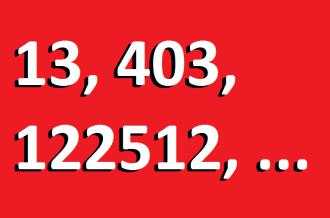
What number comes next?
[4529] What number comes next? - Look at the series (13, 403, 122512, ?), determine the pattern, and find the value of the next number! - #brainteasers #math #riddles - Correct Answers: 54 - The first user who solved this task is Fazil Hashim
BRAIN TEASERS
enter your answer and press button OK

What number comes next?

Look at the series (13, 403, 122512, ?), determine the pattern, and find the value of the next number!
Correct answers: 54
The first user who solved this task is Fazil Hashim.
#brainteasers #math #riddles
Register with your Google Account and start collecting points.
Check your ranking on list.

If you ever fall in love

If you ever fall in love… with who wants to know your favorite color and just how you like your coffee. Fall with someone who loves the way you laugh and would do absolutely anything to hear it. Fall in love with someone who puts their head on your chest just to hear your heart beat.  Fall in love with someone who kisses you in public and is proud to show you off to anyone they know. Fall in love with someone who makes you question why you were afraid to fall in love in the first place. Fall in love with someone who would never ever want to hurt you. Fall in love with someone who falls in love with your flaws and thinks you are perfect just the way you are. Fall in love with someone who thinks that you are the ONE they would love to wake up to each day.
Jokes of the day - Daily updated jokes. New jokes every day.
Follow Brain Teasers on social networks

Brain Teasers

puzzles, riddles, mathematical problems, mastermind, cinemania...

Étienne-François Geoffroy

Died 6 Jan 1731 at age 58 (born 13 Feb 1672).French chemist, who was the first to recognize the relative fixed affinities of reagents for one another. He composed tables (1718) listing the relative affinities of different reagents for particular substances, showing how one acid displaces another acid of weaker affinity for a specific base in the salt of that base. (These tables stood for most of the 18th century, until Claude-Louis Berthollet demonstrated that reactions instead depend upon the initial relative quantities of the reactants and physical conditions during the reaction.) Geoffroy considered the quest for the philosopher's stone (a substance capable of transforming base metals into gold) a delusion, but he believed that iron could be formed during the combustion of vegetable matter.
This site uses cookies to store information on your computer. Some are essential to help the site properly. Others give us insight into how the site is used and help us to optimize the user experience. See our privacy policy.