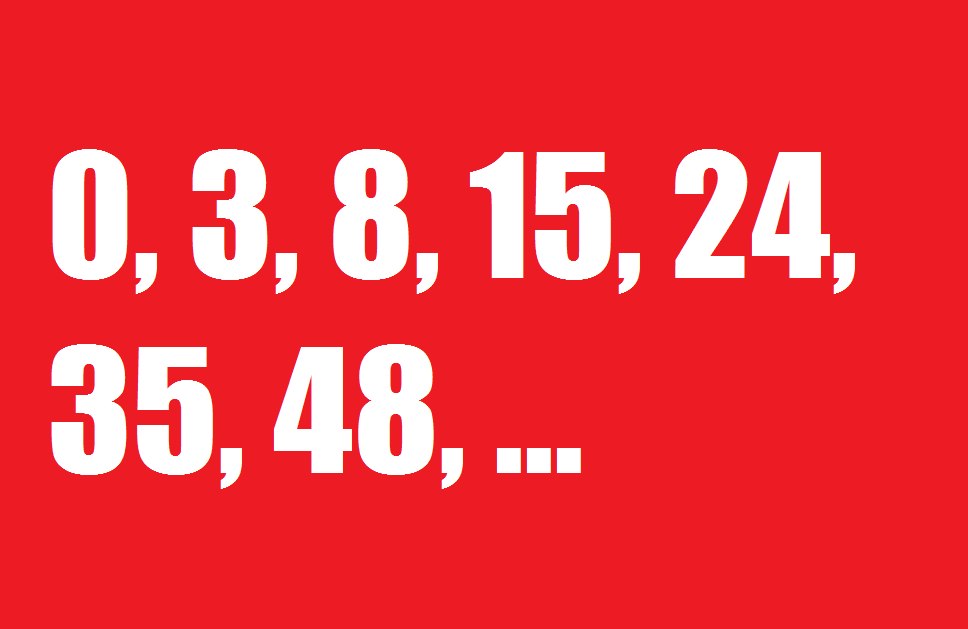
What number comes next?
[4830] What number comes next? - Look at the series (0, 3, 8, 15, 24, 35, 48, ?), determine the pattern, and find the value of the next number! - #brainteasers #math #riddles - Correct Answers: 124 - The first user who solved this task is Djordje Timotijevic
BRAIN TEASERS
enter your answer and press button OK

What number comes next?

Look at the series (0, 3, 8, 15, 24, 35, 48, ?), determine the pattern, and find the value of the next number!
Correct answers: 124
The first user who solved this task is Djordje Timotijevic.
#brainteasers #math #riddles
Register with your Google Account and start collecting points.
Check your ranking on list.

Knock Knock Collection 189


Knock Knock
Who's there?
Walt!
Walt who?
Walt till your father gets home!
Knock Knock
Who's there?
Walter!
Walter who?
Walter-wall carpeting!
Knock Knock
Who's there?
Wanda!
Wanda who?
Wanda buy some Girl Scout cookies!
Knock Knock
Who's there?
Wannetta!
Wannetta who?
Wannetta time please!
Knock Knock
Who's there?
Warner!
Warner who?
Warner you coming out to play!
Jokes of the day - Daily updated jokes. New jokes every day.
Follow Brain Teasers on social networks

Brain Teasers

puzzles, riddles, mathematical problems, mastermind, cinemania...

Spectrophotometer

In 1935, the first U.S. patent for a spectrophotometer was issued to Professor Arthur Cobb Hardy of Wellesley, Mass. (No. 1,987,441) which he called a “photometric apparatus.”It could detect two million different shades of colour and make a permanent record chart of the results. The patent was assigned to the General Electric Company of Schenectady, N.Y. which sold the first machine on 24 May 1935. It used a photo-electric device to receive light alternately from a sample and from a standard for comparison. It eliminated any need for the two beams (from sample and from standard) to travel different optical paths which in previous designs could introduce inaccuracies if one path varied from the other.«[Image: a "GE-Hardy" double-beam recording spectrophotometer photographed in 1938 showing Walt Disney with the instrument at his studios.]
This site uses cookies to store information on your computer. Some are essential to help the site properly. Others give us insight into how the site is used and help us to optimize the user experience. See our privacy policy.