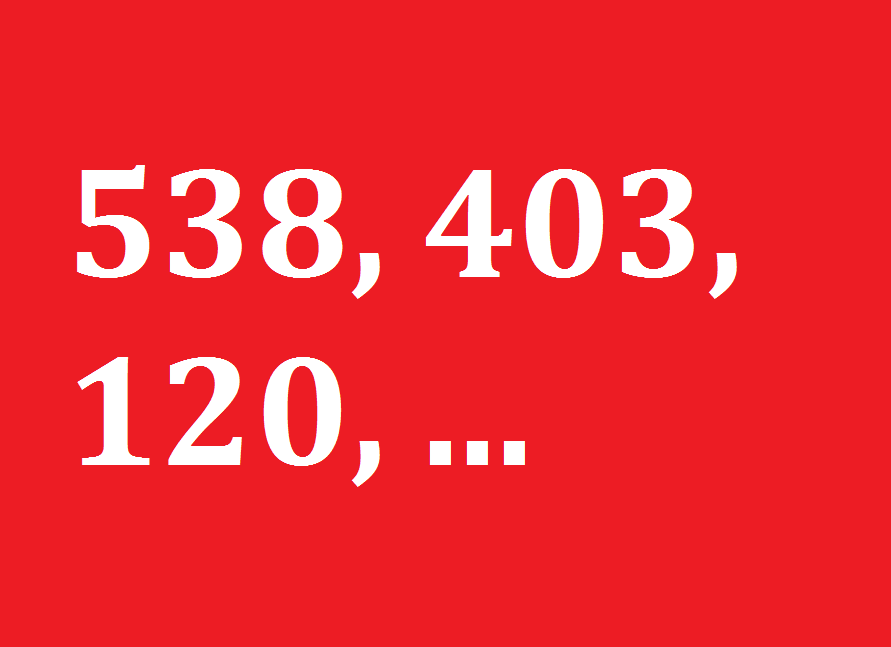
What number comes next?
[5166] What number comes next? - Look at the series (538, 403, 120, ?), determine the pattern, and find the value of the next number! - #brainteasers #math #riddles - Correct Answers: 69 - The first user who solved this task is Djordje Timotijevic
BRAIN TEASERS
enter your answer and press button OK

What number comes next?

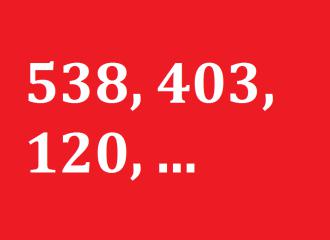
Look at the series (538, 403, 120, ?), determine the pattern, and find the value of the next number!
Correct answers: 69
The first user who solved this task is Djordje Timotijevic.
#brainteasers #math #riddles
Register with your Google Account and start collecting points.
Check your ranking on list.

On the first day of school...

On the first day of school, Peter handed his new teacher a note from his mother. The teacher unsealed the note, read it, looked at Peter with a frown, and placed the note inside a desk drawer. “So what did she write?” Peter asked. “It’s a disclaimer.”
“A what?” “It says, ‘ The opinions expressed by Peter are not necessarily those of his mother or father,’”
Jokes of the day - Daily updated jokes. New jokes every day.
Follow Brain Teasers on social networks

Brain Teasers

puzzles, riddles, mathematical problems, mastermind, cinemania...

First U.S. Patent

In 1790, the first U.S. patent was granted to Samuel Hopkins of Vermont for a process for making potash and pearl ashes. Potash was important as an ingredient in soap and fertilizer. The patent was granted for a term of 14 years and signed by President George Washington, who had the previous month signed the first U.S. patent statute into law on 10 April 1790. Hopkins did not get Patent with a serial No.1 as thousands of patents were issued before the Patent Office began to number them. Congress had passed the Patent Act on 10 Apr 1790. Two other patents were granted that year - one for a new candle-making process and the other the flour-milling machinery of Oliver Evans. The next year, 1791, Samuel Hopkins also was granted the first Canadian patent.«
This site uses cookies to store information on your computer. Some are essential to help the site properly. Others give us insight into how the site is used and help us to optimize the user experience. See our privacy policy.