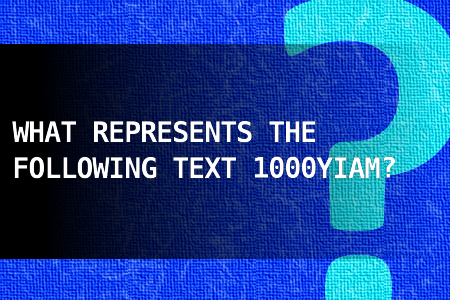
What represents the following ...
[2656] What represents the following ... - What represents the following text 1000YIAM? - #brainteasers #riddles - Correct Answers: 35 - The first user who solved this task is Roxana zavari
BRAIN TEASERS
enter your answer and press button OK

What represents the following ...

What represents the following text 1000YIAM?
Correct answers: 35
The first user who solved this task is Roxana zavari.
#brainteasers #riddles
Register with your Google Account and start collecting points.
Check your ranking on list.

Cabbie

One dismal rainy night in Sydney a taxi driver spotted an arm waving from the shadows of an alley. Even before he rolled to a stop at the curb, a figure leaped into the cab and slammed the door.

Checking his rear view mirror as he pulled away, he was startled to see a dripping wet, naked woman sitting in the back seat.

'Where to?' he stammered.

'Kings Cross,' answered the woman.

'You got it,' he said, taking another long glance in the mirror.

The woman caught him staring at her and asked, 'Just what the hell are you looking at, driver?'

'Well, madam,' he answered, 'I was just wondering how you'll pay your fare.'

The woman spread her legs, put her feet up on the front seat, smiled at the driver and said,

'Does this answer your question?'

Still looking in the mirror, the cabbie asked, 'Got anything smaller?'

Jokes of the day - Daily updated jokes. New jokes every day.
Follow Brain Teasers on social networks

Brain Teasers

puzzles, riddles, mathematical problems, mastermind, cinemania...

Sir Richard Owen

Born 20 Jul 1804; died 18 Dec 1892 at age 88. English zoologist, anatomist and palaeontologist who is remembered for his contributions to the study of fossil animals and for his strong opposition to the views of Charles Darwin. He created the word "Dinosaur" meaning "terrible reptile" (1842). Owen synthesized French anatomical work, especially from Cuvier and Geoffroy, with German transcendental anatomy. He gave us many of the terms still used today in anatomy and evolutionary biology, including "homology". In 1856, he was appointed Superintendent of the British Museum (Natural History).Image: Detail from portrait by William Holman Hunt.
This site uses cookies to store information on your computer. Some are essential to help the site properly. Others give us insight into how the site is used and help us to optimize the user experience. See our privacy policy.