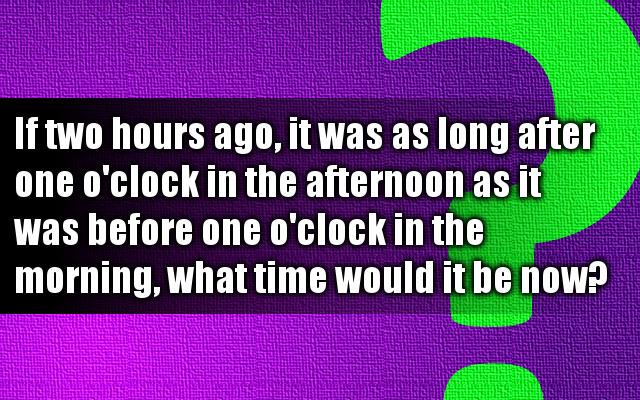
What time would it be now?
[3194] What time would it be now? - If two hours ago, it was as long after one o'clock in the afternoon as it was before one o'clock in the morning, what time would it be now? - #brainteasers #riddles - Correct Answers: 65 - The first user who solved this task is Fazil Hashim
BRAIN TEASERS
enter your answer and press button OK

What time would it be now?

If two hours ago, it was as long after one o'clock in the afternoon as it was before one o'clock in the morning, what time would it be now?
Correct answers: 65
The first user who solved this task is Fazil Hashim.
#brainteasers #riddles

Register with your Google Account and start collecting points.
Check your ranking on list.

Breakthrough?

Millions of years ago, there was no such thing as the wheel. The only way to move things was by carrying or dragging. One day, some primitive guys were watching their wives drag a dead mastodon to the food preparation area. It was exhausting work. The guys were getting tired just WATCHING.
Then they noticed some large, smooth, rounded boulders and they had an idea. They could sit on the boulders and watch! This was the first in a series of breakthroughs that ultimately led to television.
Jokes of the day - Daily updated jokes. New jokes every day.
Follow Brain Teasers on social networks

Brain Teasers

puzzles, riddles, mathematical problems, mastermind, cinemania...

Big Four British railways

In 1923, the 123 British private railway companies merged into just the “Big Four” giant regional companies. Thus were formed the London, Midland & Scottish, London & North Eastern, Great Western and Southern railways as privately owned monopolies. During WW I, all railways were placed under state control (but not ownership) and while the Railway Executive Committee prioritized war transportation needs, assets deteriorated. After the war, the benefits of central management to end destructive competition suggested nationalization for recovery. This was rejected in 1919. Instead, the Railways Act of 1921 imposed the Big Four amalgamations as private companies, effective 1 Jan 1923. Freight rates control was introduced. Nationalization came on 1 Jan 1948 after state control during WW II.«
This site uses cookies to store information on your computer. Some are essential to help the site properly. Others give us insight into how the site is used and help us to optimize the user experience. See our privacy policy.