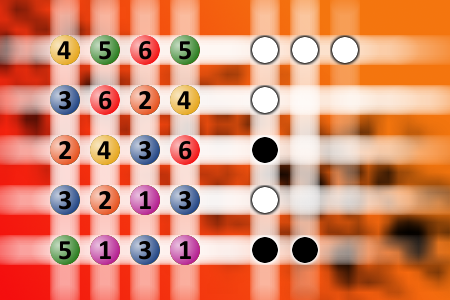
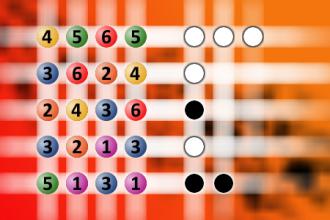
Which is a winning combination of digits?
[2990] Which is a winning combination of digits? - The computer chose a secret code (sequence of 4 digits from 1 to 6). Your goal is to find that code. Black circles indicate the number of hits on the right spot. White circles indicate the number of hits on the wrong spot. - #brainteasers #mastermind - Correct Answers: 73 - The first user who solved this task is On On Lunarbasil
BRAIN TEASERS
enter your answer and press button OK

Which is a winning combination of digits?

The computer chose a secret code (sequence of 4 digits from 1 to 6). Your goal is to find that code. Black circles indicate the number of hits on the right spot. White circles indicate the number of hits on the wrong spot.
Correct answers: 73
The first user who solved this task is On On Lunarbasil.
#brainteasers #mastermind
Register with your Google Account and start collecting points.
Check your ranking on list.

Court case

A lawyer defending a man accused of burglary tried this creative defense:

"My client merely inserted his arm into the window and removed a few trifling articles. His arm is not himself, and I fail to see how you can punish the whole individual for an offense committed by his limb."

"Well put," the judge replied. "Using your logic, I sentence the defendant's arm to one year's imprisonment. He can accompany it or not, as he chooses."

The defendant smiled.

With his lawyer's assistance, he detached his artificial limb, laid it on the bench, and walked out.

Jokes of the day - Daily updated jokes. New jokes every day.
Follow Brain Teasers on social networks

Brain Teasers

puzzles, riddles, mathematical problems, mastermind, cinemania...

Joseph Erlanger

Born 5 Jan 1874; died 5 Dec 1965 at age 91.American physiologist who discovered that fibres within the same nerve cord possess different functions. In 1910 he accepted the chair of physiology at Washington University in St. Louis, which he held until his retirement in 1946. While his department became one of the major research centers in physiology in America. Erlanger continued his work on cardiovascular physiology. During WW I, he carried out research on the problem of shock. In 1921 he shifted his interests to neurophysiology, and began joint work, with colleague Herbert Gasser, on the amplification and recording of nerve action potentials with the cathode ray oscilloscope, for which they were awarded the Nobel Prize for Physiology or Medicine in 1944.
This site uses cookies to store information on your computer. Some are essential to help the site properly. Others give us insight into how the site is used and help us to optimize the user experience. See our privacy policy.