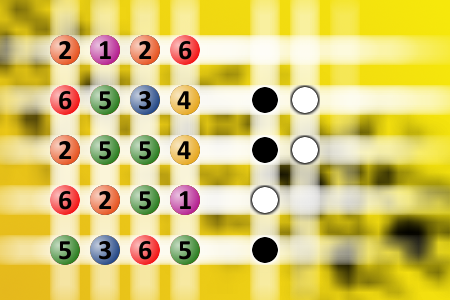
Which is a winning combination of digits?
[3872] Which is a winning combination of digits? - The computer chose a secret code (sequence of 4 digits from 1 to 6). Your goal is to find that code. Black circles indicate the number of hits on the right spot. White circles indicate the number of hits on the wrong spot. - #brainteasers #mastermind - Correct Answers: 44 - The first user who solved this task is Manguexa Wagle
BRAIN TEASERS
enter your answer and press button OK

Which is a winning combination of digits?

The computer chose a secret code (sequence of 4 digits from 1 to 6). Your goal is to find that code. Black circles indicate the number of hits on the right spot. White circles indicate the number of hits on the wrong spot.
Correct answers: 44
The first user who solved this task is Manguexa Wagle.
#brainteasers #mastermind
Register with your Google Account and start collecting points.
Check your ranking on list.

A small boy is sent to bed by...

A small boy is sent to bed by his mother...
[Five minutes later]
"Mom..."
"What?"
"I'm thirsty. Can you bring me a glass of water?"
"No. You had your chance. Lights out."
[Five minutes later]
"Mom..."
"WHAT?"
"I'm THIRSTY... Can I have a glass of water?"
"I told you NO! If you ask again I'll have to spank you!!"
[Five minutes later]
"Mom..."
"WHAT??!!"
"When you come in to spank me, can you bring me a glass of water?"
Jokes of the day - Daily updated jokes. New jokes every day.
Follow Brain Teasers on social networks

Brain Teasers

puzzles, riddles, mathematical problems, mastermind, cinemania...

Henri-Alexandre Deslandres

Born 24 Jul 1853; died 15 Jan 1948 at age 94.French astrophysicist who invented a spectroheliograph (1894) to photograph the Sun in monochromatic light (about a year after George E. Hale in the U.S.) and made extensive studies of the solar chromosphere and solar activity. He worked at the Paris and Meudon Observatories. His investigation of molecular spectra produced empirical laws presaging those of quantum mechanics. He observed spectra of planets and stars and measured their radial velocities of, and he determined the rotation rates of Uranus, Jupiter and Saturn (shortly after James E. Keeler).
This site uses cookies to store information on your computer. Some are essential to help the site properly. Others give us insight into how the site is used and help us to optimize the user experience. See our privacy policy.