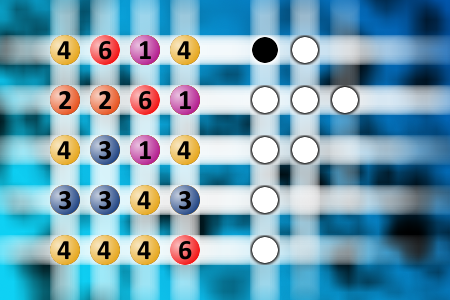
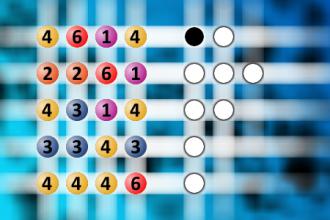
Which is a winning combination of digits?
[3915] Which is a winning combination of digits? - The computer chose a secret code (sequence of 4 digits from 1 to 6). Your goal is to find that code. Black circles indicate the number of hits on the right spot. White circles indicate the number of hits on the wrong spot. - #brainteasers #mastermind - Correct Answers: 31 - The first user who solved this task is Thinh Ddh
BRAIN TEASERS
enter your answer and press button OK

Which is a winning combination of digits?

The computer chose a secret code (sequence of 4 digits from 1 to 6). Your goal is to find that code. Black circles indicate the number of hits on the right spot. White circles indicate the number of hits on the wrong spot.
Correct answers: 31
The first user who solved this task is Thinh Ddh.
#brainteasers #mastermind
Register with your Google Account and start collecting points.
Check your ranking on list.

Sounds more like a nightmare...

An older couple wakes up in the morning and the husband looks over at his wife and says, " Wow! You wouldn't believe the dream I had..."

The wife replies, "Yes, go on tell me."

So the husband says "I had a dream that you left me after 20 years of being married."

The wife says, "Oh, it sounds more like a nightmare."

The husband says, "No, I am sure it was a dream."

Jokes of the day - Daily updated jokes. New jokes every day.
Follow Brain Teasers on social networks

Brain Teasers

puzzles, riddles, mathematical problems, mastermind, cinemania...

Charles Alfred Coulson

Born 13 Dec 1910; died 7 Jan 1974 at age 63. British theoretical chemist known for the application of molecular orbital theory to chemical bonding, the electronic structures of molecules and the concept of partial valency. He developed many mathematical techniques for solving chemical and physical problems. His molecular orbital theory treats a molecule as a whole, and extends atomic quantum theory with “allowed” states of electrons associated with two or more atomic nuclei. With this approach, he explained the structure of benzene and other conjugated systems, and using what he called partial valency, he described the bonding in such compounds as diborane. After writing on Waves (1941) and Electricity (1941), his book Valence (1952) was highly influential. He also wrote on reconciling scientific and religious views, believing religious faith was an essential in the pursuit of science.«
This site uses cookies to store information on your computer. Some are essential to help the site properly. Others give us insight into how the site is used and help us to optimize the user experience. See our privacy policy.