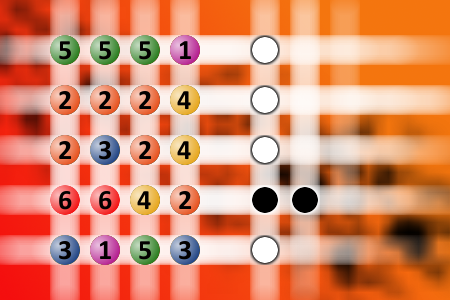
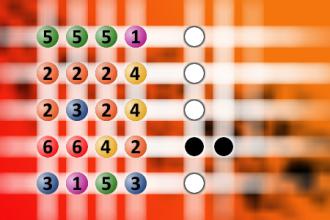
Which is a winning combination of digits?
[3995] Which is a winning combination of digits? - The computer chose a secret code (sequence of 4 digits from 1 to 6). Your goal is to find that code. Black circles indicate the number of hits on the right spot. White circles indicate the number of hits on the wrong spot. - #brainteasers #mastermind - Correct Answers: 35 - The first user who solved this task is Djordje Timotijevic
BRAIN TEASERS
enter your answer and press button OK

Which is a winning combination of digits?

The computer chose a secret code (sequence of 4 digits from 1 to 6). Your goal is to find that code. Black circles indicate the number of hits on the right spot. White circles indicate the number of hits on the wrong spot.
Correct answers: 35
The first user who solved this task is Djordje Timotijevic.
#brainteasers #mastermind
Register with your Google Account and start collecting points.
Check your ranking on list.

Paper-Eating Dog

A minister delivered a sermon in 10 minutes one Sunday morning, which was about half the usual length of his sermons. He explained, "I regret to inform you that my dog, who is very fond of eating paper, ate that portion of my sermon which I was unable to deliver this morning."After the service, a visitor from another church shook hands with the preacher and said, "Reverend, if that dog of yours has any pups, I want to give one to my minister."

Jokes of the day - Daily updated jokes. New jokes every day.
Follow Brain Teasers on social networks

Brain Teasers

puzzles, riddles, mathematical problems, mastermind, cinemania...

Marie Curie's second Nobel Prize

In 1911, at Stockholm, Sweden, Marie Curie became the first person to be awarded a second Nobel prize. She had isolated radium by electrolyzing molten radium chloride. At the negative electrode the radium formed an amalgam with mercury. Heating the amalgam in a silica tube filled with nitrogen at low pressure boiled away the mercury, leaving pure white deposits of radium. This second prize was for her individual achievements in Chemistry, whereas her first prize (1903) was a collaborative effort with her husband, Pierre Curie, and Henri Becquerel in Physics for her contributions in the discovery of radium and polonium.
This site uses cookies to store information on your computer. Some are essential to help the site properly. Others give us insight into how the site is used and help us to optimize the user experience. See our privacy policy.