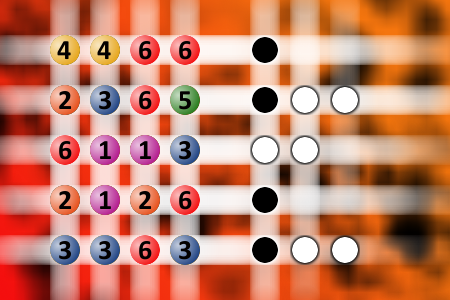
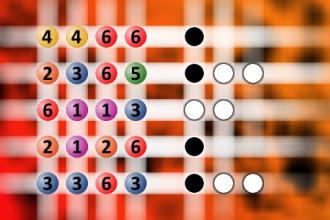
Which is a winning combination of digits?
[4704] Which is a winning combination of digits? - The computer chose a secret code (sequence of 4 digits from 1 to 6). Your goal is to find that code. Black circles indicate the number of hits on the right spot. White circles indicate the number of hits on the wrong spot. - #brainteasers #mastermind - Correct Answers: 40 - The first user who solved this task is Djordje Timotijevic
BRAIN TEASERS
enter your answer and press button OK

Which is a winning combination of digits?

The computer chose a secret code (sequence of 4 digits from 1 to 6). Your goal is to find that code. Black circles indicate the number of hits on the right spot. White circles indicate the number of hits on the wrong spot.
Correct answers: 40
The first user who solved this task is Djordje Timotijevic.
#brainteasers #mastermind
Register with your Google Account and start collecting points.
Check your ranking on list.

Three men were discussing at a...

Three men were discussing at a bar about coincidences. The first man said, " my wife was reading a "tale of two cities" and she gave birth to twins"
"That’s funny", the second man remarked, "my wife was reading 'the three musketeers' and she gave birth to triplets"
The third man shouted, "Good God, I have to rush home!"
When asked what the problem was, he exclaimed, " When I left the house, my wife was reading Ali baba and the forty Thieves"!!!
Jokes of the day - Daily updated jokes. New jokes every day.
Follow Brain Teasers on social networks

Brain Teasers

puzzles, riddles, mathematical problems, mastermind, cinemania...

Louis Pasteur

Born 27 Dec 1822; died 28 Sep 1895 at age 72. French chemist who became a founder of microbiology. He began as a chemist working on the optical properties of tartaric acid and its stereochemistry (1849). He moved into microbiology when he discovered the role of bacteria in fermentation - that it was micro-organisms in yeast causing the formation of alcohol from sugar - and proved that the growth of microorganisms was not spontaneously generated from non-living matter. This led to understanding of the germ theory of infection, and his method of killing harmful bacteria in liquids by holding them for a time at a given temperature, which is now known as pasteurisation. He created and tested vaccines for diphtheria, cholera, yellow fever, plague, rabies, anthrax, and tuberculosis.«
This site uses cookies to store information on your computer. Some are essential to help the site properly. Others give us insight into how the site is used and help us to optimize the user experience. See our privacy policy.