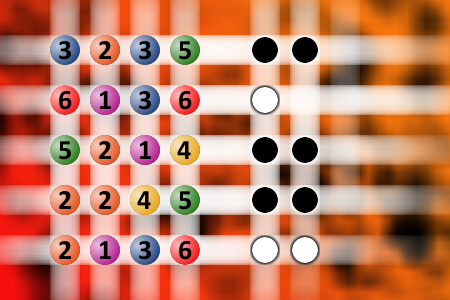

Which is a winning combination of digits?
[4786] Which is a winning combination of digits? - The computer chose a secret code (sequence of 4 digits from 1 to 6). Your goal is to find that code. Black circles indicate the number of hits on the right spot. White circles indicate the number of hits on the wrong spot. - #brainteasers #mastermind - Correct Answers: 27 - The first user who solved this task is Djordje Timotijevic
BRAIN TEASERS
enter your answer and press button OK

Which is a winning combination of digits?

The computer chose a secret code (sequence of 4 digits from 1 to 6). Your goal is to find that code. Black circles indicate the number of hits on the right spot. White circles indicate the number of hits on the wrong spot.
Correct answers: 27
The first user who solved this task is Djordje Timotijevic.
#brainteasers #mastermind
Register with your Google Account and start collecting points.
Check your ranking on list.

The Hat

An old lady was standing at the railing of the cruise ship holding her hat on tightly so that it would not blow off in the wind.
A gentleman approached her and said: "Pardon me, madam. I do not intend to be forward, but did you know that your dress is blowing up in this high wind?"
"Yes, I know," said the lady, "I need both hands to hold onto this hat."
"But, madam, you must know that your privates are exposed!" said the gentleman in earnest.
The woman looked down, then back up at the man and replied, "Sir anything you see down there is 85 years old. I just bought this hat yesterday!"  

Jokes of the day - Daily updated jokes. New jokes every day.
Follow Brain Teasers on social networks

Brain Teasers

puzzles, riddles, mathematical problems, mastermind, cinemania...

John Lubbock (Lord Avebury)

Born 30 Apr 1834; died 28 May 1913 at age 79. English banker, politician, naturalist and archaeologist who coined the terms Neolithic and Paleolithic. Like his father, astronomer Sir John William Lubbock, his scientific work was an avocation. Lubbock was a friend and advocate of Charles Darwin. He discovered the first fossil remains of musk-ox in England (1855), and undertook archaeological work identifying prehistoric cultures. As a naturalist, he studied insect vision and colour sense. He published a number of books on natural history and primitive man. In 1870, he became a member of Parliament. The legislation he initiated included the Bank Holidays Act (1871) and the Ancient Monuments Act (1882) and the Shop Hours Act (1886). He became 1st Baron Avebury when he was made a peer in 1900.«
This site uses cookies to store information on your computer. Some are essential to help the site properly. Others give us insight into how the site is used and help us to optimize the user experience. See our privacy policy.