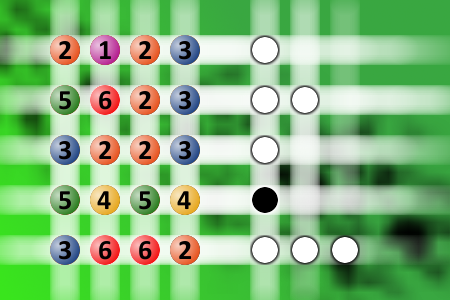
Which is a winning combination of digits?
[5285] Which is a winning combination of digits? - The computer chose a secret code (sequence of 4 digits from 1 to 6). Your goal is to find that code. Black circles indicate the number of hits on the right spot. White circles indicate the number of hits on the wrong spot. - #brainteasers #mastermind - Correct Answers: 27 - The first user who solved this task is Djordje Timotijevic
BRAIN TEASERS
enter your answer and press button OK

Which is a winning combination of digits?

The computer chose a secret code (sequence of 4 digits from 1 to 6). Your goal is to find that code. Black circles indicate the number of hits on the right spot. White circles indicate the number of hits on the wrong spot.
Correct answers: 27
The first user who solved this task is Djordje Timotijevic.
#brainteasers #mastermind
Register with your Google Account and start collecting points.
Check your ranking on list.

Only one kiss per yard

Walking up to a department store's fabric counter, the pretty girl said, "I would like to buy this material for a new dress. How much does it cost?"

"Only one kiss per yard," replied the male clerk with a smirk.

"That's fine," said the girl. "I'll take ten yards."

With expectation and anticipation written all over his face, the clerk quickly measured out the cloth, wrapped it up, then teasingly held it out.

The girl snapped up the package, pointed to the old geezer standing beside her, and smiled, "Grandpa will pay the bill."

Jokes of the day - Daily updated jokes. New jokes every day.
Follow Brain Teasers on social networks

Brain Teasers

puzzles, riddles, mathematical problems, mastermind, cinemania...

Hermann Minkowski

Died 12 Jan 1909 at age 44 (born 22 Jun 1864). German mathematician who developed the geometrical theory of numbers and who used geometrical methods to solve difficult problems in number theory, mathematical physics, and the theory of relativity. By 1907, Minkowski realised that the work of Lorentz and Einstein could be best understood in a non-euclidean space. He considered space and time, which were formerly thought to be independent, to be coupled together in a four-dimensional "space-time continuum". Minkowski worked out a four-dimensional treatment of electrodynamics. His idea of a four-dimensional space (since known as "Minkowski space"), combining the three dimensions of physical space with that of time, laid the mathematical foundation of Albert Einstein's general theory of relativity.
This site uses cookies to store information on your computer. Some are essential to help the site properly. Others give us insight into how the site is used and help us to optimize the user experience. See our privacy policy.