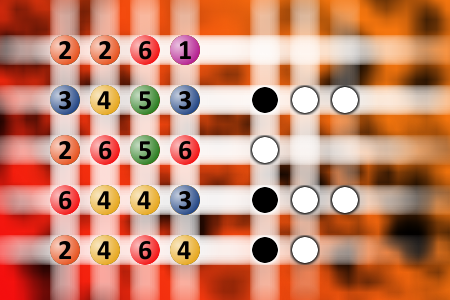
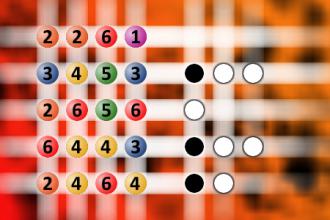
Which is a winning combination of digits?
[5385] Which is a winning combination of digits? - The computer chose a secret code (sequence of 4 digits from 1 to 6). Your goal is to find that code. Black circles indicate the number of hits on the right spot. White circles indicate the number of hits on the wrong spot. - #brainteasers #mastermind - Correct Answers: 48 - The first user who solved this task is Nílton Corrêa De Sousa
BRAIN TEASERS
enter your answer and press button OK

Which is a winning combination of digits?

The computer chose a secret code (sequence of 4 digits from 1 to 6). Your goal is to find that code. Black circles indicate the number of hits on the right spot. White circles indicate the number of hits on the wrong spot.
Correct answers: 48
The first user who solved this task is Nílton Corrêa De Sousa.
#brainteasers #mastermind
Register with your Google Account and start collecting points.
Check your ranking on list.

Detective test

A policeman was interrogating 3 SARDARS who were training to become detectives. To test their skills in recognizing a suspect, he shows the first SARDAR a picture for 5 seconds and then hides it.

"This is your suspect, how would you recognize him?"

The first SARDAR answers, "That's easy, we'll catch him fast because he only has one eye!"

The policeman says, "Well...uh...that's because the picture I showed is his side profile."

Slightly flustered by this ridiculous response, he flashes the picture for 5 seconds at the second SARDAR and asks him, "This is your suspect, how would you recognize him?"

The second SARDAR smiles, flips his hair and says, "Ha! He'd be too easy to catch because he only has one ear!"

The policeman angrily responds, "What's the matter with you two?? Of course only one eye and one ear are showing because it's a picture of his side profile! Is that the best answer you can come up with?"

Extremely frustrated at this point, he shows the picture to the third SARDAR and in a very testy voice asks, "This is your suspect, how would you recognize him? He quickly adds, "Think hard before giving me a stupid answer."

The SARDAR looks at the picture intently for a moment and says, "The suspect wears contact lenses."

The policeman is surprised and speechless because he really doesn't know himself if the suspect wears contacts or not. "Well, that's an interesting answer. Wait here for a few minutes while I check his file and I'll get back to you on that."

He leaves the room and goes to his office, checks the suspect's file in his computer, and comes back with a beaming smile on his face.

"Wow! I can't believe it. It's TRUE! The suspect does in fact wear contact lenses. Good work! How were you able to make such an astute observation?"

"That's easy," the SARDAR replied. "He can't wear regular glasses because he only has one eye and one ear."

Submitted by sai1ram

Edited by calamjo

Jokes of the day - Daily updated jokes. New jokes every day.
Follow Brain Teasers on social networks

Brain Teasers

puzzles, riddles, mathematical problems, mastermind, cinemania...

U.S. postal card

In 1872, the first U.S. postal card was authorized by Act of Congress (17 Stat. L. 304) as part of major legislation to transform the U.S. Post Office Department into an executive department. On a light buff card, about 3" x 5", a brown, one cent stamp was printed in the top right corner. Its design was a profile of the Goddess of Liberty, within an engraved border. They were first issued 1 May 1873. For the next issue (24 Aug 1885), the stamp pictured Thomas Jefferson. Later Acts authorized double postcards (3 Mar 1879) and for international use (11 Jun 1880). The first U.S. airmail postcard (10 Jan 1949) had a four-cent stamp showing an orange-red eagle in flight. The Austrian Postal Aministration had been the first in the world to authorize a Correspondz Karte(correspondance card) on 1 Oct 1869.«[Image: detail from postcard showing Goddess of Liberty stamp design.]
This site uses cookies to store information on your computer. Some are essential to help the site properly. Others give us insight into how the site is used and help us to optimize the user experience. See our privacy policy.